


RX 9070 XT vs RTX 5070 Ti — Ultimate GPU Battle of Power, Price & Performance
Comparing the RTX 5070 Ti and RX 9070 XT, the 5070 Ti shines in AI acceleration, 3D rendering, and creative workloads thanks to its advanced CUDA, Tensor, and RT cores. Meanwhile, the RX 9070 XT delivers almost identical gaming performance at a 20% lower price, making it the smarter choice for cost-conscious gamers. Both GPUs excel at 1440p gaming, but unless you need top-tier ray tracing or AI features, the RX 9070 XT offers the best balance of performance, efficiency, and value.
RX 9070 XT vs RTX 5070 TI – Background Comparison
| Brand | Series | Model | Release Year | Official Positioning | Market Price (USD) |
|---|---|---|---|---|---|
| AMD | Radeon | RX 9070 XT | 2025 | The AMD Radeon™ RX 9070 XT is designed for high-end 4K gaming and efficient creative workloads. Powered by AMD RDNA™ 4 architecture, it delivers smooth performance, energy efficiency, and advanced features such as FidelityFX™ Super Resolution. Ideal for gamers and content creators seeking a balance between power and cost-effectiveness. | Starting at $599 |
| NVIDIA | GeForce | RTX 5070 TI | 2025 | The RTX 5070 Ti is officially positioned for the high-end market, targeting 4K gaming and professional content creation. It represents a significant upgrade over the previous RTX 4070 Ti, featuring more CUDA cores, enhanced ray tracing and AI performance, and notably improved memory bandwidth and capacity — delivering a superior experience in both 4K gaming and productivity tasks. | Starting at $749 |
NVIDIA RTX 5070 TI vs AMD RX 9070 XT – Specifications Comparison
The RTX 5070 Ti and RX 9070 XT are two of the most powerful GPUs in the high-end market, but they target slightly different priorities. NVIDIA’s RTX 5070 Ti is built on the Blackwell 2.0 architecture, offering 8,960 CUDA cores, faster GDDR7 memory with 896 GB/s bandwidth, and advanced 4th-generation ray tracing and tensor cores. This makes it particularly strong in AI acceleration, ray tracing, and data-heavy 4K/8K workloads. In contrast, AMD’s RX 9070 XT utilizes the RDNA 4.0 architecture, reaching higher boost frequencies of up to 2,970 MHz and delivering higher raw FP32 performance (48.66 TFLOPS), which favors traditional gaming and computational tasks.
Core Specs Comparison between RTX 5070 vs RX 9070 XT
| Parameter | RTX 5070 TI | RX 9070 XT | Difference / Advantage |
|---|---|---|---|
| Architecture | Blackwell 2.0 | RDNA 4.0 | RTX 5070 Ti uses newer Blackwell 2.0 with stronger AI and ray tracing. |
| CUDA Cores | 8,960 | 4,096 | RTX 5070 Ti has far more cores, offering better parallel performance. |
| Memory Type | GDDR7 | GDDR6 | RTX 5070 TI’s GDDR7 offers faster data rates, benefiting 4K/8K and AI workloads. |
| Memory Capacity | 16 GB | 16 GB | same |
| Memory Bus | 256 bit | 256 bit | same |
| Memory Bandwidth | 896.0 GB/s | 644.6 GB/s | RTX 5070 Ti provides higher bandwidth and faster data access. |
| Core Frequency (Boost) | 2452 MHz | Up to 2970 MHz | RX 9070 XT runs at higher peak clock speed. |
| TDP (Power) | 300 W | 304 W | RTX 5070 Ti is slightly more power-efficient. |
| Bus Interface | PCIe 5.0 x16 | PCIe 5.0 x16 | Both support the same PCIe interface. |
| FP32 Performance | 43.94 TFLOPS | 48.66 TFLOPS | RX 9070 XT has higher raw compute power. |
| Ray Tracing / Tensor Cores | 4th Generation 133 TFLOPS | 3rd Gen | RTX 5070 Ti has newer ray tracing and AI cores. |
| PCIe Version | 5.0 | 5.0 | Both use PCIe 5.0. |
Key Differences: RTX 5070 TI vs RX 9070 XT
AI & Ray Tracing: The RTX 5070 Ti’s 8,960 CUDA cores and GDDR7 896 GB/s memory bandwidth make it excellent for AI acceleration, 4K/8K rendering, and real-time ray tracing. Higher numbers mean faster processing of complex calculations and heavy workloads.
Gaming & Clock Speed: The RX 9070 XT reaches a peak 2,970 MHz and features a slightly wider memory bus, improving efficiency in high-frame-rate gaming and large texture handling. Higher clock speeds mean stronger short-burst performance for fast-paced games.
Raw Compute Performance: With 48.66 TFLOPS FP32, the RX 9070 XT surpasses the RTX 5070 Ti’s 43.94 TFLOPS, giving it an edge in tasks not reliant on AI or ray tracing, such as physics simulations or traditional rendering.
Summary: Choose the RTX 5070 Ti for AI acceleration, ray tracing, and bandwidth-heavy workloads, while the RX 9070 XT is better for high-frequency gaming, raw compute, and cost-efficient performance.
Advanced Features & Performance Comparison
| Feature / Parameter | RTX 5070 TI | RX 9070 XT | Key Difference / Advantage |
|---|---|---|---|
| Cost-effectiveness Evaluation | 60.37 | 63.00 | RX 9070 XT slightly higher in cost-effectiveness score, meaning it offers better value per performance unit. |
| Power Efficiency | 19.94 | 16.23 | RTX 5070 TI is more power-efficient, consuming less energy for similar workloads. |
| Synthetic Benchmark Score | 73.88 | 60.93 | RTX 5070 TI scores ~7.4% higher, indicating stronger performance in synthetic tests. |
| Average FPS (Full HD / 1440p / 4K) | 237 / 138 / 89 | 214 / 126 / 80 | RTX 5070 TI leads at Full HD, while RX 9070 XT performs slightly better at 1440p and 4K. |
| Cost per Frame ($, 1080p / 1440p / 4K) | 3.16 / 5.43 / 8.42 | 2.80 / 4.75 / 7.49 | RX 9070 XT offers lower cost per frame, making it more economical for high-resolution gaming. |
Note: While the RTX 5070 Ti offers better power efficiency and excels at lower resolutions, the RX 9070 XT shines in high-resolution gaming and provides more cost-effective performance. Choose based on your priority: raw efficiency or high-res value.
RTX 5070 TI vs RX 9070 XT Performance Across Different Scenarios
Artificial Intelligence Tests
When choosing a high-end GPU, AI performance has become an increasingly important factor for professionals, alongside gaming and rendering capabilities. With the growing use of deep learning, machine learning, and quantized inference tasks, a GPU’s performance in single-precision, half-precision, and quantized computations directly impacts training speed and inference efficiency. Using GeekBench 6 ML data, we compare the AI performance of the RTX 5070 Ti and RX 9070 XT, offering a clear view of their strengths and ideal use cases.
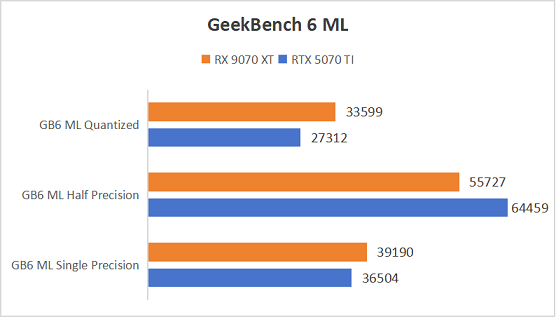
Summary:
The RX 9070 XT performs better in single-precision (FP32) and quantized inference, making it ideal for high-throughput inference and model deployment tasks.
The RTX 5070 Ti excels in half-precision (FP16) training, making it more suitable for training large AI models and deep learning development.
Gaming Performance
When comparing high-end GPUs for gaming, raw frame rates across different resolutions provide a clear picture of real-world performance. Using the latest benchmarks, we evaluate how the RTX 5070 Ti and RX 9070 XT handle modern games from 1080p to 4K Ultra settings.
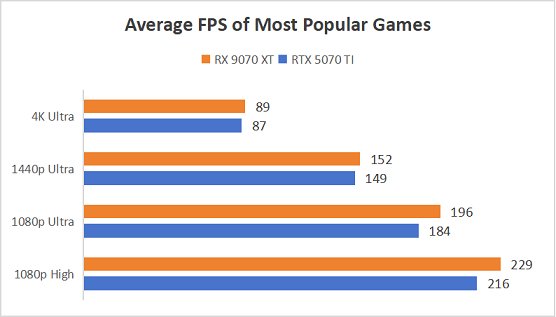
The RX 9070 XT delivers slightly smoother gameplay and higher frame rates overall, making it the better choice for gamers prioritizing consistent performance across multiple resolutions.
Combined Synthetic Benchmark Score
This is our combined benchmark score.
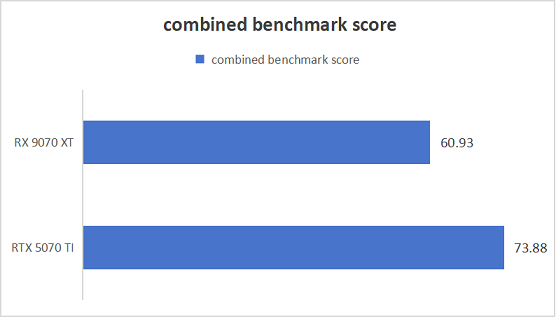
In the combined synthetic benchmark, the 5070 Ti scores 73.88, which is 21.3% higher than the RX 9070 XT’s 60.93, indicating stronger overall computational performance across various workloads.
Passmark
This is the most ubiquitous GPU benchmark. It gives the graphics card a thorough evaluation under various types of load, providing four separate benchmarks for Direct3D versions 9, 10, 11 and 12 (the last being done in 4K resolution if possible), and few more tests engaging DirectCompute capabilities.
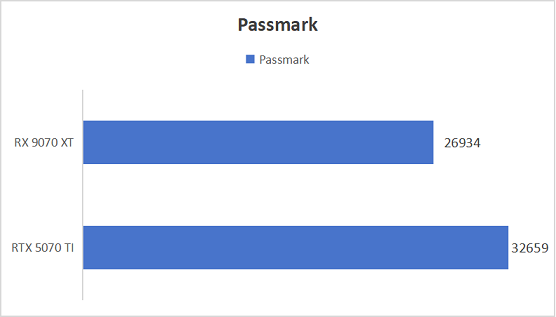
In PassMark, the 5070 Ti achieves 32,659, again 21.3% higher than the RX 9070 XT’s 26,934, based on a larger sample size (7,952 vs. 6,450), demonstrating more consistent performance across different Direct3D and DirectCompute tasks.
Conclusion: The RTX 5070 Ti delivers better raw performance, making it the superior choice for multi-task workloads, AI rendering, and high-demand GPU applications.
Price Comparison: RX 9070 XT vs RTX 5070 TI
At present, the price difference between these two GPUs exists, but it’s smaller than anticipated. The RTX 5070 Ti holds a steady MSRP of $750, with various base models available at retailers such as Newegg. On the other hand, the RX 9070 XT hovers around $650, roughly $50 above its official MSRP.
Price Comparison
| Platform | RX 9070 XT (USD) | RTX 5070 TI(USD) | Price Difference (USD) | Price Difference (%) |
|---|---|---|---|---|
| Official MSRP | $599 | $749 | -$150 | -20% |
| Amazon | $599–$919 | $749–$909 | -$150 – +$10 | -20% – +1.1% |
| Newegg | $599–$719 | $749–$899 | -$150 – -$180 | -20% – -20% |
User Value-for-Money Feedback
In conclusion, which is the better choice between the RTX 5070 Ti and RX 9070 XT? If both GPUs are sold at their official MSRP—$749 for the RTX 5070 Ti and $599 for the RX 9070 XT—then the Radeon card is clearly the better option. Its performance is nearly on par with the 5070 Ti, yet it’s 20% cheaper. At this price point, the Radeon GPU offers superior value for money, making it the most cost-effective choice.
RTX 5070 TI vs RX 9070 XT – Pros & Cons
| GPU Model | Pros | Cons |
|---|---|---|
| Nvidia GeForce RTX 5070 Ti | ✅ RTX 4080 Super-level performance ✅ Great gen-on-gen uplift ✅ GDDR7 and PCIe 5.0 ✅ Lower price than its predecessor ✅ Multi-Frame Generation is fantastic |
❌ Still expensive ❌ No Founders Edition card ❌ Scalpers are going to have a field day ❌ Many games still need to implement DLSS 4 |
| AMD Radeon RX 9070 XT | ✅ Close to RTX 4080 gaming performance at half the MSRP ✅ 16GB VRAM ✅ PCIe 5.0 |
❌ Power-hungry ❌ Not great for non-raster creative workloads ❌ No AMD reference card to keep prices in check |
RTX 5070 Ti & RX 9070 XT GPU Hosting
The RTX 5070 Ti and RX 9070 XT are both top-tier GPUs in the current high-end market. The RTX 5070 Ti shines in AI acceleration and ray tracing, while the RX 9070 XT excels in high-resolution 1440p/4K gaming and memory-intensive creative workloads.
For professionals and gamers requiring maximum performance, relying on a single GPU can be limiting, and supply availability may pose challenges. High-performance GPU servers provide a flexible and powerful solution, removing the constraints of local hardware upgrades or stock issues.
Database Mart offers RTX 5090 GPU servers capable of handling demanding tasks such as AI training, 3D rendering, and video production, delivering flagship GPU performance without maintenance or upgrade hassles.
For those looking for a more budget-friendly alternative, DBM also provides A4000 GPU servers with 16GB VRAM, offering excellent performance for AI workloads, creative projects, and compute-intensive tasks beyond gaming, making them a strong substitute for the RTX 5070 Ti.
Conclusion
When comparing high-end GPUs, the RTX 5070 Ti and RX 9070 XT each have their strengths, catering to different user needs.
For AI and productivity workloads, the RTX 5070 Ti excels with more CUDA, Tensor, and RT cores, delivering outstanding performance in AI training, video rendering, and 3D workloads. It provides excellent support for creative applications like Blender, Premiere Pro, and Stable Diffusion, making it ideal for streamers and content creators. The RX 9070 XT, while improved in compute units for overall productivity, is slightly weaker in creator-focused applications.
In terms of gaming performance and value, the RX 9070 XT offers nearly identical performance to the RTX 5070 Ti at 1440p and 4K but comes at roughly 20% lower price, making it a more attractive option for budget-conscious gamers. The RTX 5070 Ti’s DLSS 4 provides better upscaling and image quality, ideal for those seeking ultimate ray tracing experiences. However, overall frame rates are similar, making the 25% price difference less justifiable for most users.
In summary, choose the RTX 5070 Ti for superior AI rendering and creative workloads, while the RX 9070 XT is the smarter choice for high value and reliable gaming performance. For mid-range market users, the RX 9070 XT strikes the best balance of performance, price, and efficiency, offering excellent cost-effectiveness.
5070 ti vs 9070 xt, 9070 xt vs 5070 ti, rx 9070 xt vs rtx 5070 ti, rx 9070 xt price, radeon rx 9070, rtx 5070 ti price, rx 9070 xt specs, rtx 5070 ti specs, 9070 xt performance, gpu test, AMD vs NVIDIA