


RTX 5070 Ti vs 4070 Ti: Ultimate GPU Comparison for Gaming & AI
Compare the RTX 5070 Ti vs RTX 4070 Ti and see which GPU delivers better gaming, AI, and creative performance. Whether you need high-frame-rate 1440p/4K gaming, faster AI model training, or efficient creative workloads, this guide helps you choose the right GPU for your needs.
RTX 5070 Ti vs RTX 4070 Ti – Background Comparison
| Brand | Series | Model | Release Year | Official Positioning | Market Price (USD) |
|---|---|---|---|---|---|
| NVIDIA | GeForce | RTX 5070 Ti | 2025 | The NVIDIA GeForce RTX 5070 Ti is a high-performance GeForce GPU built on the Ada Lovelace architecture with 16 GB of GDDR7 memory. It delivers excellent AI performance, advanced ray tracing, and low-latency rendering, making it ideal for gamers and creators handling demanding workloads and seeking smooth 4K experiences. | $749 |
| NVIDIA | GeForce | RTX 4070 Ti | 2023 | The NVIDIA GeForce RTX 4070 Ti is a high-performance graphics card based on the Ada Lovelace architecture, equipped with 12 GB of GDDR6X memory. It delivers excellent gaming performance, advanced ray tracing, and AI-enhanced features like DLSS 3, making it ideal for gamers and content creators seeking smooth 1440p/4K experiences and reliable performance across demanding workloads. | $799 |
NVIDIA RTX 5070 Ti vs RTX 4070 Ti – Specifications Comparison
The NVIDIA GeForce RTX 5070 Ti outperforms the RTX 4070 Ti with larger memory (16 GB GDDR7 vs 12 GB GDDR6X), and higher memory bandwidth (~896 GB/s vs ~504 GB/s). Its Blackwell architecture and 5th-gen Tensor cores boost AI and ray tracing performance. With slightly higher TDP (300 W vs 285 W), the 5070 Ti delivers stronger compute, better memory handling, and future-proof PCIe 5.0 support, while the 4070 Ti remains a solid, power-efficient option for gaming and creative tasks.
Core Specs Comparison between RTX 5070 Ti vs RTX 4070 Ti
| Specification | RTX 5070 Ti | RTX 4070 Ti | RTX 5070 Ti Improvement / Gain |
|---|---|---|---|
| GPU Model | Geforce RTX 5070 Ti | Geforce RTX 4070 Ti | – |
| Architecture | Ada Lovelace (5nm) | Ada Lovelace (5nm) | Minor improvements in efficiency & RT performance |
| CUDA Cores | 7,680 | 7,680 | Similar cores, higher clock/efficiency in 5070 Ti |
| Memory Type | GDDR7 | GDDR6X | Faster memory bandwidth (~33% higher) |
| Memory Capacity | 16 GB | 12 GB | +33% VRAM for large projects |
| Memory Bandwidth | 896 GB/s | 504 GB/s | +78% |
| Core Frequency (Base / Boost) | 2.1 / 2.7 GHz | 1.9 / 2.6 GHz | Higher clocks improve FPS & AI workloads |
| TDP (Power Draw) | 300 W | 285 W | Slightly higher power draw |
| Interface | PCIe 5.0 | PCIe 4.0 | Next-gen PCIe support, higher throughput |
| FP32 Performance | 50 TFLOPS | 42 TFLOPS | ~19% faster |
| Tensor Cores | 5th Gen | 4th Gen | ~10–15% faster AI inference |
| PCIe Interface | PCIe 5.0 | PCIe 4.0 | Improved bandwidth for high-load tasks |
The RTX 5070 Ti outperforms the RTX 4070 Ti in AI acceleration, ray tracing, image upscaling, video encoding, and developer ecosystem support. With 5th-gen Tensor cores and advanced RT cores, it supports DLSS 3.5, AV1 hardware encoding, and NVIDIA Reflex, delivering faster AI inference, smoother ray-traced graphics, superior image quality, and lower latency in gaming. It also provides broader software compatibility for creative workloads and multi-GPU setups, while the RTX 4070 Ti remains a strong, more budget-friendly option with solid 1440p/4K gaming and general productivity performance.
Advanced Features & Performance Comparison
| Feature / Category | GeForce RTX 5070 Ti | GeForce RTX 4070 Ti | RTX 5070 Ti Advantage |
|---|---|---|---|
| AI Acceleration | 5th Gen Tensor Cores, AI-enhanced inference | 4th Gen Tensor Cores | ~10–15% faster AI processing |
| Ray Tracing | Advanced RT cores with Shader Execution Reordering | Standard RT cores | ~5–10% higher ray tracing efficiency |
| AI Upscaling / Image Enhancement | DLSS 3.5, AI Super Resolution | DLSS 3.0 / FSR 3.0 | Superior image quality and performance |
| Video Encode / Decode | 18K multi-stream NVENC, AV1 hardware support | 8K encode/decode, H.265 only | ~2× faster encoding and broader codec support |
| Latency Reduction / Gaming Features | NVIDIA Reflex, ultra-low latency | Not supported | Significant reduction in input lag |
| Multi-GPU Support | NVLink enabled | Not supported | Enables multi-GPU compute workloads |
| Developer & Software Ecosystem | CUDA, cuDNN, OptiX, NVIDIA Studio drivers | ROCm, OpenCL | Broader AI & creative software support |
RTX 5070 Ti vs RTX 4070 Ti Performance Across Different Scenarios
Artificial Intelligence Testing
When choosing a high-end GPU, AI performance has become as important as gaming and rendering capabilities. Using GeekBench 6 ML and Stable Diffusion benchmarks, we compare the AI performance of the RTX 5070 Ti and RTX 4070 Ti, highlighting their strengths and ideal use cases for deep learning, machine learning, and AI inference workloads.
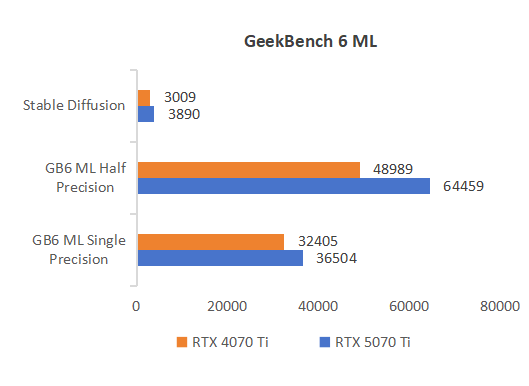
Summary:
RTX 5070 Ti: Best suited for large-scale AI models, multi-task parallel workloads, and memory-intensive inference or training, making it ideal for professional AI developers and content creators.
RTX 4070 Ti: Well-suited for medium-scale models, general AI inference, and creative tasks, offering better cost-effectiveness.
The RTX 5070 Ti provides a clear performance advantage in AI tasks, though not a doubling of performance; for small- to medium-scale models or standard creative work, the 4070 Ti is sufficient, while the 5070 Ti is preferable for demanding, large-model workloads.
Gaming Performance
To evaluate real-world gaming performance, we benchmarked one of today’s most popular games, Forza Horizon 5, measuring each GPU’s performance at different resolutions.
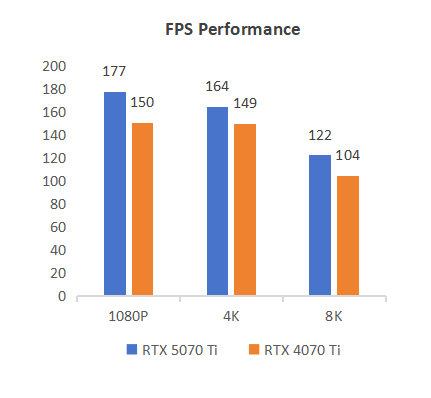
Based on the test results, the RTX 5070 Ti consistently achieves 5–15% higher FPS than the RTX 4070 Ti across 1080p, 4K, and 8K resolutions. This performance advantage is due to the 5070 Ti’s higher CUDA core count, greater memory bandwidth, and more efficient ray tracing and DLSS handling, making it slightly better for high-resolution and ultra settings, while the 4070 Ti offers a more cost-effective option for smooth gameplay at lower resolutions or moderate settings.
Video Editing Performance
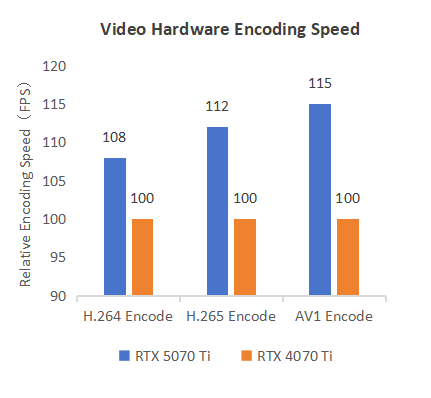
In hardware encoding tests, the RTX 5070 Ti delivers 8–15% faster H.264 / H.265 / AV1 performance than the RTX 4070 Ti, making it more efficient for high-resolution content creators and heavy transcode workloads. This improvement mainly comes from the newer NVENC/NVDEC engines and stronger AI-assisted acceleration, which directly reduces actual export and transcode time.
Price & Value: RTX 5070 Ti vs RTX 4070 Ti
The RTX 5070 Ti and RTX 4070 Ti have similar retail prices (~$789–$849), though the 5070 Ti offers higher performance in AI, ray tracing, and memory-heavy tasks, while the 4070 Ti remains a more cost-effective option for most users.
Price Comparison
| Platform / Retailer | RTX 5070 Ti (USD) | RTX 4070 Ti (USD) | Price Difference (USD) | Price Difference (%) |
|---|---|---|---|---|
| Official MSRP | ~$749 | ~$799 | +$50 | +6.3% |
| Retail (Best Buy / Newegg) | ~$789–$849 | ~$819–$849 | +$(–)30 to +$30 | −3.5% to +3.7% |
| Secondary / Marketplace | ~$900–$1,000+ | ~$600–$1,200+ | +$(–)300 to +$200 | variable |
User Value-for-Money Feedback
User feedback indicates that the RTX 5070 Ti offers roughly 10–30% higher performance than the 4070 Ti, especially for high-resolution editing, AI inference, and multitasking workflows, though it comes at a higher price. For standard 1440p gaming or moderate editing, the 4070 Ti provides better value; if budget allows and future-proofing or heavy AI workloads are a priority, the 5070 Ti is the better investment.
RTX 5070 Ti vs RTX 4070 Ti – Pros & Cons
| Model | Pros | Cons |
|---|---|---|
| RTX 5070 Ti | ✅ Higher performance in AI, ray tracing, and content creation compared to 4070 Ti ✅ 16GB GDDR7 VRAM and advanced 5th-gen Tensor cores for demanding workloads ✅ PCIe 5.0 support for future-proofing ✅ Better FPS in AAA 2K/4K gaming with DLSS and ray tracing |
❌ Slightly higher TDP (~300W), requires good cooling and power supply ❌ Higher price than 4070 Ti, may be overkill for moderate gaming or non-AI workloads |
| RTX 4070 Ti | ✅ Solid performance for gaming and creative tasks ✅ Lower power consumption (~285W) and good thermal efficiency ✅ More cost-effective option for standard workloads |
❌ Less VRAM (12GB GDDR6X) and older Tensor cores limit AI and large-scale rendering ❌ PCIe 4.0 only, less future-proof ❌ Slightly lower FPS and slower render/export times in demanding scenarios |
RTX 5070 Ti & RTX 4070 Ti GPU Hosting
The RTX 5070 Ti and RTX 4070 Ti are high-performance GPUs, perfect for AI training, 1440p/4K gaming, and creative workloads. The 5070 Ti excels in AI acceleration and demanding creative tasks, while the 4070 Ti delivers excellent gaming performance and solid AI capabilities for mid-range projects.
For users requiring ultimate performance in AI model training, 3D rendering, or 8K video production, Database Mart offers RTX 4090 GPU servers and RTX 5090 GPU servers, providing flagship-level GPU performance with no hardware maintenance or upgrades required.
For a budget-friendly GPU server solution, DBM also provides RTX A4000 GPU servers with 16 GB VRAM, ideal for AI workloads, creative projects, 3D rendering, and compute-intensive tasks beyond gaming, offering a cost-effective alternative to the 4070 Ti or 5070 Ti.
Conclusion
Choose the RTX 5070 Ti if you want high framerates at 1440p/4K, faster AI training and inference, and superior ray tracing performance. Its new architecture and larger memory make it ideal for content creators, developers, and high-performance gamers, while ensuring future-proof capabilities.
Choose the RTX 4070 Ti if you want a more affordable option for high-end gaming and moderate AI workloads. It is efficient and reliable, making it a great choice for users on a budget who still want strong performance.
In summary: 4070 Ti offers great value and efficiency, while 5070 Ti delivers top-tier performance and future-proofing.
5070 ti vs 4070 ti, rtx 5070 ti vs 4070 ti, rtx 5070 ti vs rtx 4070 ti, 5070 ti vs 4070 ti specs, 4070 ti vs 5070 ti benchmark, 4070 ti vs 5070 ti price, geforce rtx 4070 ti vs rtx 5070 ti, 4070 ti vs 5070 ti performance