


5070 Ti vs 5080: Is the RTX 5080 Really Worth the Upgrade?
In 2025, choosing the right high-performance GPU is more important than ever. The comparison between the 5070 Ti and 5080 has drawn considerable attention, as both belong to NVIDIA’s RTX 50 Series Blackwell lineup yet differ significantly in price and performance, making the choice challenging for many gamers.
This article provides a thorough analysis of RTX 5070 Ti vs 5080, covering gaming performance, creative workloads, power consumption, and price, while also explaining 5070 Ti vs RTX 5080 specs. With these insights, you can better understand the real-world performance of 5070 Ti vs 5080 and make the choice that suits you best. Whether you are an esports gamer, a 4K ray-tracing enthusiast, or a video editing/3D rendering creator, this guide offers clear guidance for deciding between the 5070 Ti and the RTX 5080.
Summary of RTX 5070 Ti vs 5080
The NVIDIA RTX 50 Series Blackwell GPUs have become a benchmark for high-performance graphics in 2025, featuring a new architecture, enhanced ray-tracing performance, and improved energy efficiency, catering to everything from high-frame-rate esports to 4K creative workloads.
Distinct Positioning:
Both the 5070 Ti and rtx 5080 use NVIDIA’s latest GB203 Blackwell GPU, delivering excellent performance in ray tracing, AI acceleration, and multitasking. While they belong to the same RTX 50 Series Blackwell lineup, they differ in performance, price, and positioning, targeting different user groups.
- RTX 5070 Ti: Focuses on cost-effectiveness and high-frame-rate gaming, ideal for 1080p/1440p gamers.
- RTX 5080: A flagship GPU targeting ultimate performance, 4K ray tracing, and professional creative workloads.
Shared Advantages:
- Supports the latest ray-tracing technology and DLSS 3 acceleration.
- Stable driver optimization and wide software compatibility.
- Strong multitasking capabilities, able to handle both gaming and creative workloads.
This article will delve into these features and advantages, providing a detailed comparison of rtx 5070ti vs 5080, explaining rtx 5080 vs 5070 ti specs, and considering 5070 ti price to help you make the best choice.
5070 Ti vs 5080: Launch Background Comparison
| Item | RTX 5070 Ti | RTX 5080 |
|---|---|---|
| Release Date | March 2025 | June 2025 |
| Launch Price | $749 | $999 |
| Positioning | Mid-to-high-end gaming, cost-effective | Flagship GPU, ultimate performance and creative efficiency |
| Power Consumption | ~220W | ~320W |
| VRAM | 12GB GDDR6 | 16GB GDDR6X |
| Key Technologies | Ray Tracing, DLSS 3, AI acceleration | Ray Tracing, DLSS 3, AI acceleration, higher FP32 performance |
| Target Users | Mid-range gamers, budget-conscious players | High-end gamers, 4K ray-tracing enthusiasts, professional creators |
Based on launch background, the 5070 Ti is a mid-to-high-end model in the RTX 50 Series, emphasizing cost-effectiveness and high-frame-rate gaming, with a relatively affordable launch price, making it suitable for most esports and mid-range gamers. The RTX 5080, on the other hand, is a flagship GPU targeting users seeking ultimate performance, 4K ray tracing, and professional creative efficiency, with higher VRAM and power consumption, capable of handling more demanding gaming and creative workloads.
RTX 5080 vs 5070 Ti Specifications
| Parameter | 5070 Ti | RTX 5080 |
|---|---|---|
| GPU Model | GB203-300 | GB203 |
| Architecture | Blackwell | Blackwell |
| CUDA Cores | 8,960 | 10,752 |
| Memory Type | GDDR7 | GDDR7 |
| Memory Capacity | 16 GB | 16 GB |
| Memory Bandwidth | 896 GB/s | 960 GB/s |
| Core Frequency (Base / Boost) | 2295 / 2452 MHz | 2295 / 2617 MHz |
| TDP | 300 W | 360 W |
| Interface | PCIe 5.0 x16 | PCIe 5.0 x16 |
| FP32 Performance | 43.94 TFLOPS | 56.28 TFLOPS |
| Tensor Cores | 280 | 336 |
| PCIe Version | PCIe 5.0 | PCIe 5.0 |
Core Specs Summary
On paper, the differences between the 5070 Ti and RTX 5080 are relatively small, giving us a preliminary sense of their close performance potential. The RTX 5080 has approximately 20% more CUDA cores, 25% more RT cores, and 20% more Tensor cores than the 5070 Ti, which translates to higher theoretical throughput for gaming, ray tracing, AI acceleration, and creative workloads.
Both cards feature the same 16 GB GDDR7 memory, and while the newer GDDR7 slightly increases memory speed, its effect on overall memory bandwidth is minimal. This means that for many real-world scenarios, memory will not be the limiting factor; performance gains come mainly from the increased core counts and higher boost frequencies.
Overall, the 5070 Ti is well-suited for high-frame-rate 1080p/1440p gaming and mid-range creative tasks, offering excellent value for cost-conscious users. The RTX 5080, with higher core counts and boost clocks, is ideal for 4K gaming, heavy ray tracing, and professional creative workloads like 4K/8K video editing or 3D rendering, where every bit of extra computational power counts.
RTX 5080 vs 5070 Ti: Performance Across Different Scenarios
Gaming Performanc
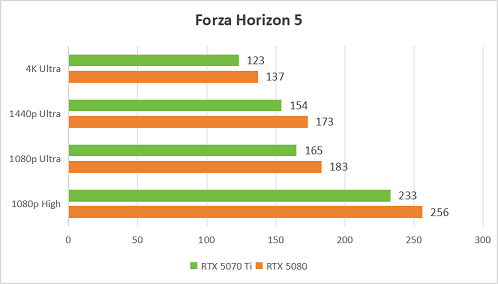
Based on the benchmark data for Forza Horizon 5, the RTX 5080 consistently outperforms the RTX 5070 Ti across all tested resolutions, though the performance gap varies slightly depending on resolution and settings.
- At 1080p High, RTX 5080 achieves 256 FPS compared to 233 FPS for 5070 Ti, approximately 10% faster. At 1080p Ultra, the difference increases to 11% .
- At 1440p Ultra, the performance gap is around 12% .
- At 4K Ultra, RTX 5080 leads by roughly 11% , highlighting its advantage in GPU-intensive scenarios where higher resolution increases the load.
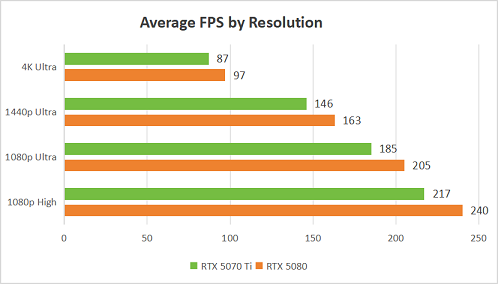
The averaged FPS dataset confirms the trend: RTX 5080 achieves 240/205 FPS at 1080p High/Ultra, 163 FPS at 1440p Ultra, and 97 FPS at 4K Ultra, all consistently higher than the 5070 Ti . The margin of error is low, indicating reliable and stable performance differences.
Overall, both cards provide high-quality gaming experiences, but the RTX 5080 is better suited for 1440p Ultra or 4K Ultra gameplay, where its higher core counts and boost clocks make a noticeable difference. The 5070 Ti remains a strong choice for 1080p High/Ultra, offering slightly lower FPS but excellent cost-effectiveness.
3DMark Synthetic Benchmark Results
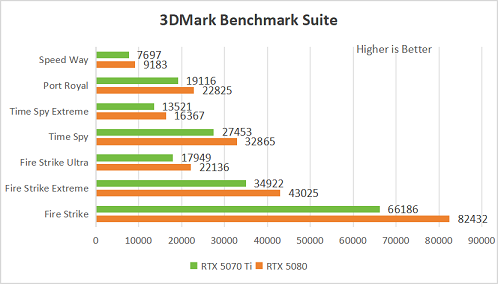
Starting with synthetic benchmarks, the 3DMark results clearly show the RTX 5080 outperforming the RTX 5070 Ti across all tests.
- Fire Strike series (DX11): The RTX 5080 leads by 23–25% .
- Time Spy series (DX12):The performance gap remains strong, with the RTX 5080 ahead by 20–21% .
- Ray tracing tests:In both Port Royal and Speed Way, the RTX 5080 is about 19% faster.
In short: across rasterization, DX12 workloads, and ray tracing, the RTX 5080 shows a consistent 18–25% performance advantage over the RTX 5070 Ti. While synthetic benchmarks don’t perfectly represent real-world gameplay, they provide a clear baseline of the performance gap before looking at gaming results.
Artificial Intelligence Tests
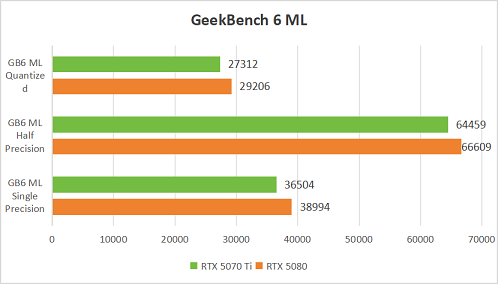
Based on the three core throughput tests in GeekBench 6 ML (Single, Half, and Quantized Precision), the RTX 5080 delivers a consistent 6–8% performance lead over the RTX 5070 Ti. This steady advantage across all precision types indicates that the RTX 5080 provides stronger overall AI capability, offering more reliable throughput, improved inference speed, and better mixed-precision performance for general AI workloads and lightweight training tasks.
RTX 5070 Ti vs RTX 5080 — User Recommendation & Value Analysis
| GPU Model | MSRP (Official) | Amazon / Official Channel | Third-party / Reseller |
|---|---|---|---|
| RTX 5070 Ti | US$ 749 | $ 789–1,303 (Amazon) | $ 820–1,399 |
| RTX 5080 | US$ 999 | $ 1,472–2,017 (Amazon) | $ 1,400–1,600 |
Value Summary
If you’re a budget-conscious gamer looking for solid performance, or a mid-tier content creator, especially someone who mainly plays at 1080p or 1440p, the RTX 5070 Ti is a highly practical choice.
- Why choose it? This card handles most high-frame-rate games and light content creation tasks with ease. It’s also much more affordable than the RTX 5080. If you can grab it close to the official MSRP (US$ 749), it offers excellent value.
- Is it worth it? ✅ Absolutely. Particularly when the price is near MSRP or slightly above, it’s a balanced option for mid-to-high-end gamers and creators.
If you’re a high-end gamer, 4K ray-tracing enthusiast, or a professional creator working on video editing, 3D rendering, or AI workloads, the RTX 5080 delivers a noticeable performance boost.
- Why choose it? It significantly outperforms the 5070 Ti, making it ideal for those who demand extreme graphics quality or heavy content creation. However, it comes with a premium price tag.
- Is it worth it? ⚠️ For users seeking top-tier performance, yes—it’s a worthwhile investment. For casual gaming or light content creation, the value proposition isn’t as strong compared to the 5070 Ti.
GeForce RTX 5070 Ti vs RTX 5080 Pros & Cons
| GPU | Pros | Cons |
|---|---|---|
| RTX 5070 Ti | ✅ High cost-performance ratio ✅ Good for 1080p/1440p high-FPS gaming ✅ Capable for light content creation ✅ Relatively low power consumption |
❌ Slightly weaker than RTX 5080 ❌ May struggle in heavy workloads or some games ❌ Market prices can exceed MSRP |
| RTX 5080 | ✅ Powerful performance, ideal for 4K gaming & heavy workloads ✅ GDDR7 memory & PCIe 5.0 support ✅ Excellent cooling and stability |
❌ Expensive, lower cost-performance ❌ High power and cooling requirements ❌ Performance gains may be limited in low-res gaming |
Conclusion
In conclusion, after analyzing RTX 5070 Ti vs RTX 5080 across gaming, creative workloads, and AI performance, the RTX 5080 generally comes out ahead in demanding scenarios, particularly in 4K gaming, high-quality ray tracing, and professional content creation. Its performance remains more stable under heavy workloads.
That said, considering the 5070 Ti price and overall cost-effectiveness, the RTX 5070 Ti is more than adequate for most 1080p–1440p gamers and light content creators, with performance approaching that of the RTX 5080 in certain mid-range scenarios.
Personal Recommendation:
If your priority is extreme performance and future-proofing, the RTX 5080 is worth the investment. However, for most gamers and creators who want a solid balance between performance and price, the RTX 5070 Ti is already highly capable and arguably the smarter choice.
5070 ti vs 5080, rtx 5070ti vs 5080, rtx 5080 vs 5070 ti, rtx 5070 ti vs 5080, 5070ti vs 5080, 5070 ti price, 5070 ti, rtx 5080, rtx 5080 vs 5070 ti specs, rtx 5070 ti