


RTX 5090 vs 5080: Is the 16 GB Upgrade Worth It?
Which GPU truly defines next-gen performance — the RTX 5090 or RTX 5080? Built on NVIDIA’s new Blackwell architecture, both cards push gaming and creative workflows further than ever. The RTX 5090 doubles the CUDA cores and AI TOPS of the 5080, boasting 32 GB of ultra-fast GDDR7 memory and 1.8 TB/s bandwidth for demanding AI, 3D, and 8K creation.
The RTX 5080, meanwhile, balances power and efficiency with 16 GB of GDDR7 and a lower 360 W TDP, making it ideal for high-end 4K gamers and creators. In short, the RTX 5090 is made for professionals chasing absolute performance, while the RTX 5080 offers next-gen speed without the extreme power draw or price.
Summary Light of 5090 & 5080
Performance: RTX 5090 doubles the CUDA cores and AI TOPS of the 5080, offering unmatched speed for AI, rendering, and 8K content creation.
Memory: 32 GB GDDR7 on the 5090 vs 16 GB GDDR7 on the 5080 — ideal for handling larger datasets, textures, and models.
Power & Efficiency: 5090 delivers extreme power (575 W TDP), while 5080 strikes a sweet balance at 360 W for high-end 4K gaming and creative workloads.
Use Case:
RTX 5090: Best for professionals, researchers, and creators needing top-tier performance and future-proof capability.
RTX 5080: Perfect for gamers and creators seeking strong 4K performance without the premium cost or power demand.
RTX 5090 vs 5080 – Background Comparison
Both GPUs are part of NVIDIA’s 50 series desktop lineup. Released on January 30, 2025, the 5090 targets enthusiasts and professionals needing high-end gaming and AI performance, while the 5080 serves users who want strong 4K gaming and content creation without breaking the bank.
The architecture, Blackwell 2.0, brings improvements in ray tracing, tensor cores, and DLSS, ensuring both GPUs support the latest software and games.
| Brand | Series | Model | Release Year | Official Positioning | Market Price (USD) |
|---|---|---|---|---|---|
| NVIDIA | GeForce | RTX 5090 | 2025 | The GeForce RTX 5090 is NVIDIA's most powerful GeForce GPU to date, based on the Blackwell architecture, equipped with 32GB of high-speed GDDR7 memory, designed for gaming and creative workloads, and delivering unprecedented AI performance. | Starting at $1,999 |
| NVIDIA | GeForce | RTX 5080 | 2025 | The GeForce RTX 5080 is NVIDIA’s high-performance GeForce GPU, based on the Blackwell architecture, equipped with 16GB of high-speed GDDR7 memory, designed for gaming and creative workloads, offering excellent AI performance. | Starting at $999 |
NVIDIA 5090 vs 5080 – Specifications Comparison
Core 5090 and 5080 Specs
| Parameter | RTX 5090 | RTX 5080 | RTX 5090 Improvement |
|---|---|---|---|
| Architecture | Blackwell | Blackwell | — (same generation) |
| CUDA Cores | 21,760 | 10,752 | +102% more cores |
| Memory Type | GDDR7 | GDDR7 | — |
| Memory Capacity | 32 GB | 16 GB | 2× larger VRAM |
| Memory Bandwidth | 1,792 GB/s | 960 GB/s | +86.7% increase |
| Core Frequency (Base/Boost) | 2.01 GHz / 2.41 GHz | 2.30 GHz / 2.62 GHz | Slightly lower (–8% avg) |
| TDP (Total Graphics Power) | 575 W | 360 W | +60% power draw |
| Interface | PCIe 5.0 x16 | PCIe 5.0 x16 | — |
| FP32 Performance | 104.8 TFLOPS | 56.28 TFLOPS | +86% compute boost |
| Tensor Cores (AI) | 5th Gen 3352 AI TOPS | 5th Gen 1801 AI TOPS | +86% AI throughput |
| PCIe Generation | Gen 5 | Gen 5 | — |
Advanced Features Comparison
| Feature | RTX 5090 | RTX 5080 |
|---|---|---|
| Memory Bus Width | 512-bit | 256-bit |
| Memory Clock | 1750 MHz | 1875 MHz |
| Resizable BAR | + | + |
| Display Connectors | 1x HDMI 2.1b, 3x DP 2.1b | 1x HDMI 2.1b, 3x DP 2.1b |
| DirectX | 12 Ultimate (12_2) | 12 Ultimate (12_2) |
| DLSS | + | + |
Key Differences – 5090 vs 5080
CUDA Cores: The RTX 5090 has 21,760 cores, almost double the RTX 5080’s 10,752, giving it far superior parallel computing and rendering capabilities.
Core Clock: While the RTX 5080 has slightly higher base and boost clocks, its lower core count means overall performance is still behind the 5090.
VRAM Capacity & Bandwidth: With 32 GB GDDR7 and 1.79 TB/s bandwidth, the RTX 5090 handles large textures and datasets much better than the 16 GB/960 GB/s of the 5080, critical for high-resolution gaming and professional workloads.
FP32 Performance: RTX 5090 achieves 104.8 TFLOPS versus 56.28 TFLOPS on the 5080, making it ideal for AI training, 3D rendering, and heavy computational tasks.
Power Consumption: The 5090 draws more power at 575 W, but the performance gains justify the higher TDP for professional and enthusiast use.
RTX 5090 vs 5080 Benchmark: Performance Across Different Scenarios
RTX 5090 vs 5080 AI Performance
AI Performance (Geekbench AI): The 5090 leads by 18.87%, demonstrating better AI throughput thanks to higher memory capacity and more Tensor cores. While the 5080 is close, the 5090 provides more headroom for large AI models and professional workloads.
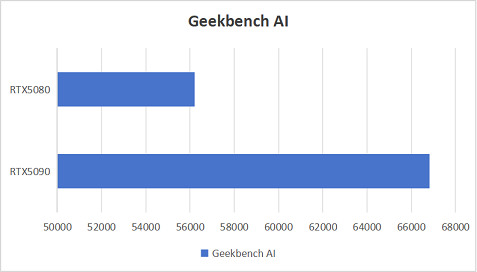
Geekbench AI’s half-precision score is more about frequency than cores. That’s why RTX 5080’s pretty close.
Although the RTX 5090 offers higher overall AI performance, the RTX 5080 still holds several strengths, especially in small-batch AI tasks and efficient workloads.The RTX 5080 outperforms RTX 5090 in small-batch image generation, making it a strong choice for lightweight AI workloads.
RTX 5090 vs 5080 Gaming Performance
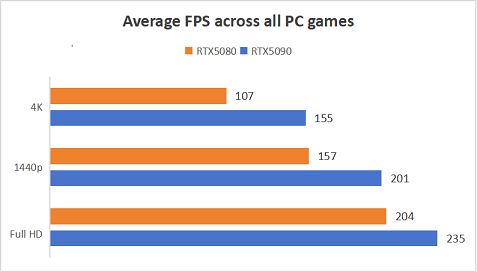
- Full HD: RTX 5090 averages 235 FPS, about 15% higher than RTX 5080’s 204 FPS.
- 1440p: RTX 5090 reaches 201 FPS, approximately 28% higher than RTX 5080’s 157 FPS.
- 4K: RTX 5090 achieves 155 FPS, around 45% higher than RTX 5080’s 107 FPS.
- Summary: The performance gap increases with resolution, making the 5090 ideal for high-resolution gaming and professional workloads, while the 5080 suits users with moderate performance needs.
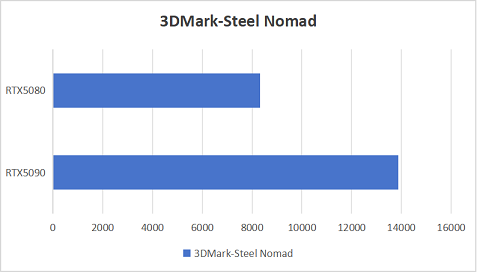
Steel Nomadperforms a bit differently on these cards, but it still delivers about 60% of Big Boy’s performance, which aligns perfectly with expectations for a GPU-intensive benchmark.
Aggregate performance score
We've compared GeForce RTX 5090 and GeForce RTX 5080, covering specs and all relevant benchmarks.
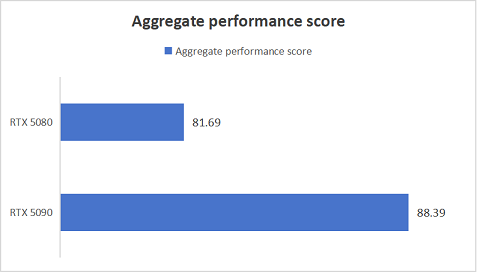
According to synthetic benchmarks, the RTX 5090 achieves a score of 88.39, while the RTX 5080 scores 81.69.
RTX 5090 vs RTX 5080
AI Performance: The 5090 outperforms the 5080 by approximately 19%, providing greater stability for large models and professional AI workloads.
Gaming Performance: Both cards perform similarly, with the 5090 slightly better at high resolutions and ultra settings.
Summary: Heavy AI users should opt for the 5090, while the 5080 is sufficient for gaming purposes.
Price & Value: RTX 5090 vs 5080
| Platform | RTX 5090 (USD) | RTX 5080 (USD) | Price Difference (USD) | Price Difference (%) |
|---|---|---|---|---|
| Official MSRP | starting at $1,999 | starting at $999 | +$1,000 | +100% |
| Amazon | $2,599 – $6,045 | $999 – $4,419 | +$1,600 – +$1,626 | +160% – +162% |
| eBay | $2,401 – $49,998 | $999 – $2,695 | +$1,402 – +$47,303 | +140% – +1,780% |
Notes / Explanation:
For the Official MSRP line, the $1,000 difference from $999 to $1,999 represents a 100% increase (doubling the price).
On Amazon, if RTX 5090 is $2,599 and RTX 5080 is $999, then difference is $1,600, which is ~160%. If the 5080 is higher (say $4,419 upper bound), difference is smaller in percentage terms—hence the range.
On eBay, the difference range is large because the high-end listings of 5090 can go extremely high ($49,998) compared to the 5080 upper range ($2,695), giving very large percentage spreads.
In terms of value, the RTX 5090 offers around 20% higher AI performance and 45% better 4K gaming FPS than the 5080, making it the top choice for performance-focused users. For budget-conscious users, the 5080 delivers solid performance at a much better price-to-performance ratio.
RTX 5090 vs 5080 – Pros & Cons
| Model | Pros | Cons |
|---|---|---|
| RTX 5080 | ✅ Much lower price than 5090, good value for high-end gaming ✅ Efficient for 1440p and 4K gaming with moderate settings ✅ Lower power consumption (360 W) |
❌ Lower CUDA cores and FP32 performance ❌ Limited VRAM (16 GB) may restrict AI/3D rendering tasks ❌ Future-proofing is weaker compared to RTX 5090 |
| RTX 5090 | ✅ Massive CUDA cores (21,760) and VRAM (32 GB) ideal for 4K gaming, AI workloads, and professional 3D rendering ✅ Extremely high FP32 and ray-tracing performance ✅ Great future-proofing for demanding tasks |
❌ High price ($1,999 MSRP) ❌ High power consumption (575 W) ❌ Gains mostly visible in memory-intensive or compute-heavy tasks, less impact on casual gaming |
Server Hosting: RTX 5090 vs 5080
Buying an RTX 5090 outright can be costly, and managing high-end GPUs requires technical know-how for maintenance, cooling, and uptime monitoring. Server hosting solves these challenges by providing ready-to-use, professionally maintained hardware without the upfront investment.
Databasemart offers dedicated RTX 5090 hosting servers with single or multi-GPU setups, 99.9% uptime, and 24/7 expert support. This allows you to run AI workloads, rendering tasks, or high-resolution simulations efficiently while leaving all the hardware management to us. Hosting ensures flexibility, cost-effectiveness, and reliability, so you can focus entirely on your projects.
Conclusion
The RTX 5090 is ideal for professionals handling large datasets, complex 3D rendering, or advanced AI workloads, while the RTX 5080 suits mid-level users with moderate rendering, gaming, or AI tasks. Though pricier, Databasemart’s 5090 hosting provides ready-to-use servers with 24/7 support, making it a hassle-free, cost-effective choice for demanding applications.
5090 vs 5080, 5080 vs 5090, rtx 5080 vs 5090, gpu benchmark comparison, graphics card benchmarks, gpu performance chart, 5090 price, 5080 price, gpu comparisons, nvidia geforce, gpu test, 5080 specs, 5090 specs