


NVIDIA RTX PRO 6000 vs A100 – Which Professional GPU Is Worth Your Money?
A detailed comparison of NVIDIA PRO 6000 vs A40 , analyzing performance, power efficiency, and value to help you choose the best professional GPU.”
NVIDIA RTX PRO 6000 VS A100 – Background Comparison
| Brand | Series | Model | Release Year | Official Positioning | Market Price (USD) |
|---|---|---|---|---|---|
| NVIDIA | RTX PRO | RTX PRO 6000 | 2025 | Built on NVIDIA’s Ada Lovelace architecture, the RTX PRO 6000 is designed for professional workstations, delivering powerful AI inference, real-time ray tracing, and advanced graphics performance for 3D rendering, content creation, and engineering workflows. | ~$6,800 |
| NVIDIA | Data Center | A100 | 2020 | The NVIDIA A100 Tensor Core GPU is built on the Ampere architecture and is designed for data centers, offering exceptional performance for AI training, deep learning, and high-performance computing (HPC) workloads with high-bandwidth HBM memory and NVLink support. | ~$10,000–15,000 |
NVIDIA RTX PRO 6000 VS A100– Specifications Comparison
The NVIDIA RTX PRO 6000 and NVIDIA A100 serve different professional workloads. The RTX PRO 6000, built on the Ada Lovelace architecture, is designed for workstations, offering extremely high FP32 performance, more CUDA cores, and advanced Tensor Cores, making it ideal for AI inference, 3D rendering, and professional visualization. In contrast, the A100, based on the Ampere architecture, is a data center GPU optimized for large-scale AI training, deep learning, and HPC, featuring HBM memory, high bandwidth, and multi-instance GPU (MIG) support. In short, choose the RTX PRO 6000 for local workstation performance and rendering, and the A100 for data center AI training and high-performance computing.
Core Specs Comparison between NVIDIA RTX PRO 6000 VS A100
| Specification | RTX PRO 6000 | NVIDIA A100 | Improve / Gain |
|---|---|---|---|
| GPU Model | NVIDIA RTX PRO 6000 | NVIDIA A100 | Different product class: Workstation vs Data Center |
| Architecture | Ada Lovelace | Ampere | RTX PRO 6000 is one generation newer |
| CUDA Cores | 18,176 | 6,912 | RTX PRO 6000 has ~2.6× more CUDA cores |
| Memory Type | GDDR6 ECC | HBM2 / HBM2e | A100 uses HBM for HPC workloads |
| Memory Capacity | 48 GB | 40 GB / 80 GB | A100 offers higher max capacity (80 GB) |
| Memory Bandwidth | ~960 GB/s | ~1,555 GB/s | A100 provides ~60% higher bandwidth |
| Core Frequency (Base / Boost) | ~1.9 / 2.5 GHz | ~1.1 / 1.4 GHz | RTX PRO 6000 has significantly higher clock speeds |
| TDP (Power Draw) | ~300 W | ~250–400 W | RTX PRO 6000 is more power-efficient for workstations |
| Interface | PCIe | PCIe / SXM | A100 supports SXM for data centers |
| FP32 Performance | ~90 TFLOPS | ~19.5 TFLOPS | RTX PRO 6000 delivers ~4.5× FP32 performance |
| Tensor Cores | 568 (4th Gen) | 432 (3rd Gen) | RTX PRO 6000 has newer Tensor Core generation |
| PCIe Interface | PCIe 4.0 x16 | PCIe 4.0 x16 | Equivalent |
The RTX PRO 6000 is designed for workstations, offeringlow latency, and stable memory for rendering and AI inference. The A100 targets data centers, excelling in mixed-precision AI training, high bandwidth, and multi-instance GPU scaling for large-scale HPC and deep learning tasks.
Advanced Feature Comparison between NVIDIA RTX PRO 6000 VS A100
| Advanced Performance | RTX PRO 6000 | NVIDIA A100 | Improve / Gain |
|---|---|---|---|
| AI / Inference Performance | Optimized for AI inference and workstation tasks | Optimized for large-scale AI training | RTX PRO 6000 better for inference; A100 better for training |
| Mixed-Precision / AI Training | Supports FP16 for inference | FP16 / BF16 / TF32 / INT8 optimized for AI training | A100 excels at large-scale AI workloads |
| Memory & Bandwidth | 48–96 GB GDDR6 ECC, ~960 GB/s | 40–80 GB HBM2e, ~1,555 GB/s | A100 higher bandwidth for HPC; RTX PRO 6000 stable for workstation tasks |
| Multi-Instance / Multi-GPU | Supports vGPU for multiple workstation apps | Supports MIG 7+ instances, NVLink for GPU clusters | A100 excels at parallel AI workloads; RTX PRO 6000 optimized for workstation multi-GPU |
| Latency vs Throughput | Low latency for interactive rendering & inference | High throughput for batch AI training & HPC | RTX PRO 6000 better for real-time tasks; A100 better for large-scale AI |
NVIDIA RTX PRO 6000 VS A100 Performance Across Different Scenarios
Artificial Intelligence Testing
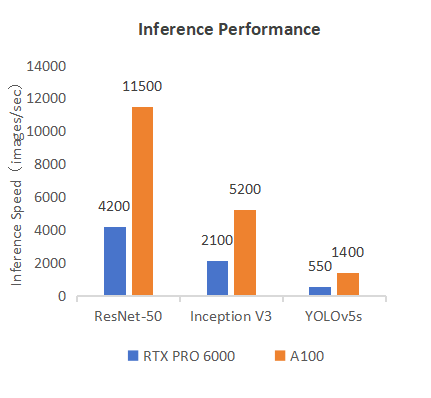
The A100 outperforms the RTX PRO 6000 by ~2–3× on the same AI models due to higher FP16 throughput, memory bandwidth, and Tensor Core acceleration, making it ideal for large-scale AI training. The PRO 6000, while slower for heavy AI tasks, remains cost-effective for graphics, rendering, and small- to medium-scale AI inference.
3D Rendering
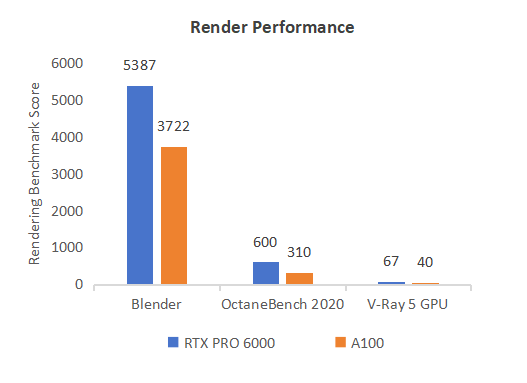
The chart shows that the RTX PRO 6000 significantly outperforms the A100 in rendering tasks. For example, in Blender and OctaneBench, PRO 6000 achieves ~5387 and 600 points respectively, compared with A100’s ~3722 and 310 points. This performance advantage is due to PRO 6000’s higher FP32 throughput and dedicated RT cores, optimized for professional graphics and GPU rendering. In contrast, the A100 is designed for AI/HPC workloads and does not excel in rendering tasks.
Price & Value: NVIDIA RTX PRO 6000 VS A100
The RTX PRO 6000 and NVIDIA A100 occupy different professional segments, with the A100 generally costing $5,300–$6,500 more than the PRO 6000, representing a 46%–57% price increase depending on retailer or marketplace. While the A100 excels in large-scale AI training, high-bandwidth HPC workloads, and multi-instance GPU tasks, the RTX PRO 6000 delivers high workstation performance, low-latency AI inference, and professional rendering at a lower cost. For users seeking cost-efficient workstation performance and real-time AI/rendering workloads, the PRO 6000 is ideal, whereas the A100 is better suited for data center training, HPC, and massive AI model deployments.
Price Comparison
| Platform / Retailer | RTX PRO 6000 (USD) | NVIDIA A100 (USD) | Price Difference (USD) | Price Difference (%) |
|---|---|---|---|---|
| Official MSRP | ~$4,999 | ~$11,000 | –$6,001 | –55% |
| Retail / Resellers | ~$4,800–$5,500 | ~$10,500–$12,000 | –$5,700–$6,500 | –54%––46% |
| Secondary / Marketplace | ~$4,200–$5,000 | ~$9,500–$11,500 | –$5,300–$6,500 | –56%––57% |
User Value-for-Money Feedback
User value‑for‑money feedback generally shows that the RTX PRO 6000 delivers very strong performance per dollar in professional graphics, rendering, and design workloads compared with the A100, because it costs significantly less while still handling most 3D, CAD, and VFX tasks well. The A100, although much more expensive, adds higher raw performance, Tensor Core acceleration, and AI/HPC optimizations, so it’s considered better value only if those features or heavy AI workloads matter to the user.
NVIDIA RTX PRO 6000 VS A100 – Pros & Cons
| Model | Pros | Cons |
|---|---|---|
| RTX PRO 6000 | ✅ Strong performance for professional graphics, 3D rendering, CAD, and VFX workloads ✅ Excellent price-to-performance for traditional graphics tasks ✅ Large 48 GB VRAM for complex scenes ✅ Efficient for workstation use |
❌ Lacks AI/HPC optimizations and Tensor Core acceleration ❌ Much less suitable for large-scale AI training compared to A100 ❌ Expensive compared to consumer GPUs |
| A100 | ✅ Exceptional AI training and HPC performance ✅ Tensor Cores and high memory bandwidth accelerate deep learning workloads ✅ Highly future-proof for AI/compute-heavy applications ✅ Massive scalability in data centers |
❌ Extremely high cost ❌ Overkill for traditional graphics or design tasks ❌ Requires specialized power/cooling and data center setup ❌ Not optimized for general workstation graphics |
NVIDIA RTX PRO 6000 VS A100 Hosting
The RTX PRO 6000 and A100 cater to high-end professional and AI/computing performance needs, making them suitable for 3D rendering, CAD, VFX, video production, and GPU-accelerated workloads.
For individuals, teams, or organizations needing GPU resources without investing in local hardware, GPU hosting provides a flexible and cost-effective solution. Database Mart offers RTX PRO 6000 GPU Server and A100 GPU Server , providing access to powerful GPUs on demand.
The RTX PRO 6000 offers cost-efficient performance for professional graphics, 3D rendering, CAD, and video workloads. The A100 delivers higher raw performance with Tensor Cores and AI/HPC optimizations, making it ideal for large-scale AI and high-performance computing. A100 is only better value for extreme AI or compute-heavy tasks.
Conclusion
RTX PRO 6000: High-end professional GPU, excellent for 3D rendering, CAD, VFX, video editing, and GPU-accelerated workloads. Cost-efficient for graphics tasks with large VRAM (48 GB), but not optimized for heavy AI training.
A100: Data-center GPU designed for AI training, HPC, and large-scale compute workloads. Exceptional raw performance and Tensor Core acceleration, but extremely expensive and overkill for traditional graphics tasks.
Summary: RTX PRO 6000 excels at professional graphics and rendering with strong cost-to-performance, while A100 is ideal for large AI and compute-heavy workloads. A100 is only better value when AI/HPC performance is required; otherwise, PRO 6000 is more practical for graphics tasks.
RTX PRO 6000 vs A100, nvidia rtx pro 6000 vs a100, rtx pro 6000 vs a100 performance, rtx pro 6000 vs a100 training, rtx pro 6000 vs a100 inference, rtx pro 6000 vs a100 benchmark, rtx pro 6000 vs a100 price