


RTX 6000 Ada vs RTX 4090 – AI and 3D Rendering Performance Comparison
Dive into the RTX 6000 Ada vs RTX 4090 comparison, covering architecture, memory, FP32 and AI performance, gaming and 3D rendering benchmarks, price analysis, and recommended GPU server alternatives for professional and consumer workloads.
Summary Light of RTX 6000 Ada vs RTX 4090
Key Features
When comparing RTX 6000 Ada vs RTX 4090, the primary difference lies in their design focus. The RTX 6000 Ada is positioned as a professional workstation GPU, prioritizing stability, certified drivers, and consistent performance for long-running workloads. The RTX 4090, on the other hand, emphasizes raw performance and peak throughput, which is why it leads many RTX 4090 benchmark rankings.
Industries
Both GPUs are used across creative, AI, and visualization workloads, but they target different user groups. The RTX 6000 Ada is more commonly deployed in enterprise and professional environments, while the RTX 4090 is widely adopted by gamers, creators, and performance-focused workstations. In the context of rtx 6000 ada vs 4090, the choice often depends on whether professional stability or maximum performance is the priority.
Popular Software
The RTX 6000 Ada and RTX 4090 support most modern creative and AI software platforms, including 3D creation tools, video editing applications, machine learning frameworks, and real-time engines. Both GPUs integrate well with today’s production pipelines and software ecosystems, with differences becoming more apparent in advanced professional workflows and sustained workloads.
RTX 6000 Ada vs RTX 4090 – Background Comparison
The RTX 6000 Ada is a professional workstation GPU focused on stability and large memory for enterprise workloads, while the RTX 4090 targets high-end consumer performance, excelling in gaming and creative tasks.
The key distinction in rtx 6000 ada vs rtx 4090 lies in professional reliability versus peak compute power.
| Brand | Series | Model | Release Year | Official Positioning / Description | Market Price (USD) |
|---|---|---|---|---|---|
| NVIDIA | RTX Professional Ada Series | RTX 6000 Ada | 2022 | Professional workstation GPU designed for enterprise, AI, and advanced visualization workloads | ~$6,800–$7,500 |
| NVIDIA | GeForce RTX 40 Series | RTX 4090 | 2022 | Flagship consumer GPU focused on extreme performance for gaming and creative applications | ~$1,600–$2,000 |
NVIDIA RTX 6000 Ada vs RTX 4090 – Specifications Comparison
Core RTX 6000 Ada vs RTX 4090 Specs
| Parameter | RTX 6000 Ada | RTX 4090 | Difference / Advantage |
|---|---|---|---|
| Architecture | Ada Lovelace | Ada Lovelace | Same architecture, optimized differently for professional vs consumer |
| CUDA Cores | 18,176 | 16,384 | RTX 6000 Ada has more cores for sustained professional workloads |
| Memory Type | GDDR6 ECC | GDDR6X | ECC support in RTX 6000 Ada for professional reliability |
| Memory Capacity | 48 GB | 24 GB | RTX 6000 Ada offers much larger VRAM |
| Memory Bus | 384-bit | 384-bit | Same memory bus width |
| Memory Bandwidth | ~960 GB/s | ~1,008 GB/s | RTX 4090 slightly higher peak bandwidth |
| Core Frequency (Boost) | ~2.4 GHz | ~2.52 GHz | RTX 4090 slightly higher clocks |
| TDP (Power) | ~300 W | ~450 W | RTX 4090 draws more power, higher peak performance |
| Interface / Bus | PCIe Gen4 | PCIe Gen4 | Same interface |
| FP32 Performance | ~60 TFLOPS | ~82 TFLOPS | RTX 4090 has higher peak FP32 compute, but Ada excels in sustained workloads |
| Ray Tracing / Tensor | 3rd-gen RT, 4th-gen Tensor | 3rd-gen RT, 4th-gen Tensor | Same generation, Ada optimized for professional rendering |
| PCIe Version | Gen4 | Gen4 | Same version |
Advanced Features Comparison
| Feature / Capability | RTX 6000 Ada | RTX 4090 | Difference / Advantage |
|---|---|---|---|
| Professional Software Certification | Autodesk, SolidWorks, Siemens NX, Blender, Unreal Engine | Blender, Unreal Engine, Premiere Pro, PyTorch, TensorFlow | Ada is certified for enterprise / professional pipelines |
| Multi-Display Support | 4x DisplayPort 1.4a, 1x HDMI 2.1 | 3x DisplayPort 1.4a, 1x HDMI 2.1 | Ada optimized for multi-monitor professional setups |
| AI & ML Optimization | Transformer Engine + CUDA cores for large-scale AI training | Tensor cores + CUDA for fast inference | Ada specialized for sustained AI workloads |
| Ray Tracing / Rendering | Optimized for precise professional 3D rendering | Optimized for high-performance gaming and creative rendering | Ada better for stability under long rendering sessions |
| DLSS / Upscaling | DLSS 3 (professional pipelines tuning) | DLSS 3 / Frame Generation for consumer workloads | Ada tuned for consistent visual fidelity |
| Video Encoding / Decoding | Dual NVENC, AV1, H.265, H.264 | Dual NVENC, AV1, H.265, H.264 | Both support modern codecs, Ada prioritized for workstation use |
| Thermal & Power Management | Efficient ~300 W TDP, designed for sustained workloads | Up to ~450 W TDP, designed for peak performance | Ada more power-efficient for long-term operations |
| Target Workloads | Enterprise AI, scientific computing, CAD/CAE, professional visualization | Gaming, content creation, high-end desktop compute | Ada for reliability & stability, 4090 for peak performance |
| Certification & Support | Enterprise-level driver support & software validation | Consumer-grade drivers and support | Ada preferred in mission-critical environments |
Key Differences: RTX 6000 Ada vs RTX 4090
Architecture & AI / Ray Tracing
– Both RTX 6000 Ada and RTX 4090 use the Ada Lovelace architecture, but they are optimized differently. RTX 6000 Ada focuses on professional workloads with stable 3rd‑gen RT cores and 4th‑gen Tensor cores, ensuring consistent performance in long AI training sessions, 3D rendering, and enterprise visualization. RTX 4090 emphasizes peak performance for consumer and creator tasks, with slightly higher FP32 throughput and high-speed Tensor cores, ideal for gaming, real-time rendering, and short-term intensive AI inference.
VRAM Capacity
– RTX 6000 Ada features 48 GB GDDR6 ECC, allowing servers to handle extremely large AI models, scientific datasets, and high-resolution rendering without memory bottlenecks. In contrast, RTX 4090 has 24 GB GDDR6X, sufficient for gaming and most creative workloads, but may limit performance in sustained enterprise or AI tasks where larger memory buffers are required.
FP32 / Compute Performance
– RTX 4090 delivers ~82 TFLOPS of peak FP32 compute, giving it an edge for short-term, peak-intensive workloads such as 3D rendering or game development. RTX 6000 Ada offers ~60 TFLOPS, which is lower in peak throughput but more stable under continuous high-load operations, making it ideal for servers running AI training or professional visualization tasks over long periods.
AI Acceleration & Tensor Performance
– RTX 6000 Ada’s Transformer Engine + Tensor cores are optimized for sustained AI and machine learning workloads, providing reliable throughput for large models and batch processing. RTX 4090 is more geared toward fast inference and real-time AI tasks, delivering high frame rates or fast computations but with less focus on long-term stability under heavy server loads.
Power & Thermal Efficiency
– RTX 6000 Ada has a TDP around 300 W, designed for consistent performance and efficient thermal management in servers. RTX 4090 peaks at ~450 W, offering higher short-term performance but requiring more cooling and power headroom, which can limit deployment in power-constrained server environments.
Target Use Case
– RTX 6000 Ada excels in enterprise AI, professional rendering, scientific computing, and certified software pipelines, ensuring stability for continuous workloads. RTX 4090 is optimized for high-end gaming, creative content production, and performance-focused desktop servers, delivering peak performance in shorter bursts rather than sustained enterprise tasks.
🔍 Choosing between RTX 6000 Ada and RTX 4090?
If your server workload demands stable, long-term performance for AI training, professional rendering, or scientific computing, the RTX 6000 Ada is the better choice. If you need peak performance for high-end gaming, creative content production, or fast inference tasks, the RTX 4090 excels in short-term intensive workloads.
👉 Share your workload, and we’ll provide a tailored GPU server recommendation with a free monthly cost estimate.
RTX 6000 Ada vs RTX 4090 Benchmark: Performance Across Different Scenarios
RTX 6000 Ada vs RTX 4090 Gaming Performance
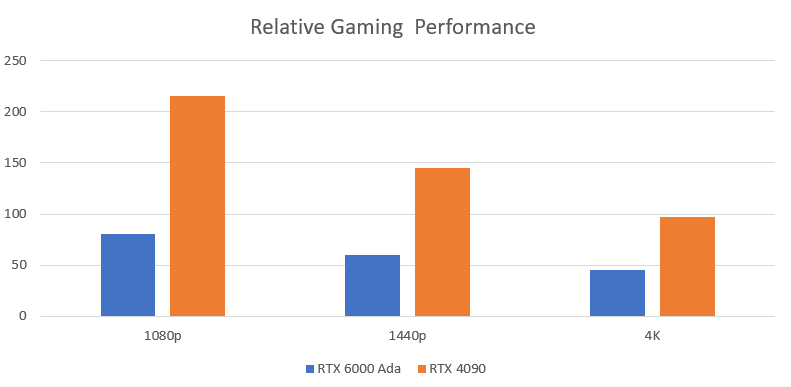
In gaming scenarios, the performance difference between the RTX 6000 Ada and RTX 4090 is substantial. At 1080p, the RTX 4090 reaches 216 FPS, nearly 2.7× higher than the 80 FPS of the RTX 6000 Ada. At 1440p, the gap remains large, with 145 FPS versus 60 FPS, and at 4K, the RTX 4090 achieves 97 FPS compared to 45 FPS on the RTX 6000 Ada.
These results reflect the different target markets of the two GPUs: the RTX 4090 is a consumer-focused GPU, optimized for gaming and creative workloads, capable of delivering very high frame rates across 1080p, 1440p, and 4K AAA games. In contrast, the RTX 6000 Ada is a professional-grade GPU designed for AI, HPC, and enterprise workloads. Its gaming performance is limited due to drivers and architecture optimized for sustained compute rather than real-time rendering.
RTX 6000 Ada vs RTX 4090 – 3D Rendering Performance
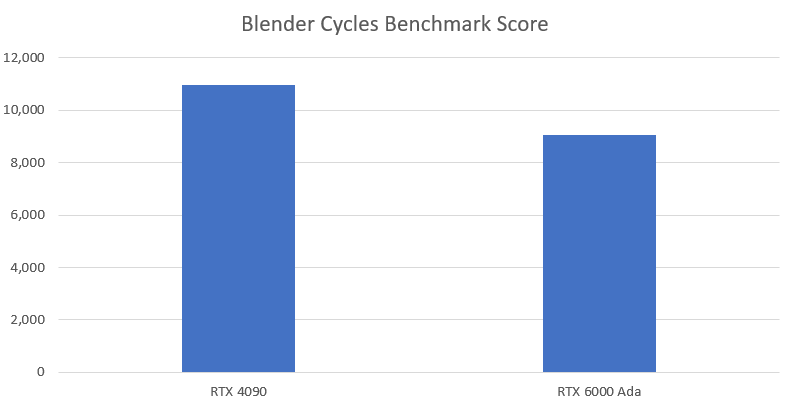
In 3D rendering workloads, the RTX 4090 and RTX 6000 Ada serve very different purposes. According to Blender Cycles benchmarks, the RTX 4090 achieves ~10,945 points, while the RTX 6000 Ada scores ~9,038, showing that the 4090 typically renders standard scenes ~21% faster. This makes the 4090 strong for single-frame rendering and smaller projects.
The RTX 6000 Ada is a professional GPU with 48GB VRAM, more CUDA and RT cores, and higher FP32 compute (~91 TFLOPS vs 82 TFLOPS for the 4090). These specs allow it to handle ultra-large scenes, massive textures, and multi-instance batch rendering, ideal for enterprise, AI, and HPC workloads, even though single-frame FPS may lag behind the 4090.
In practice:
- RTX 4090 → Faster single-scene rendering, ideal for designers or artists needing quick turnaround.
- RTX 6000 Ada → Supports massive datasets and multiple simultaneous rendering instances, perfect for studios, AI pipelines, and professional visualization projects.
Key takeaway: While the 4090 delivers superior raw speed for typical 3D rendering, the 6000 Ada’s memory capacity and professional architecture provide the headroom necessary for complex, large-scale rendering tasks. This makes it ideal for enterprise or HPC-focused workloads.
AI Image Generation
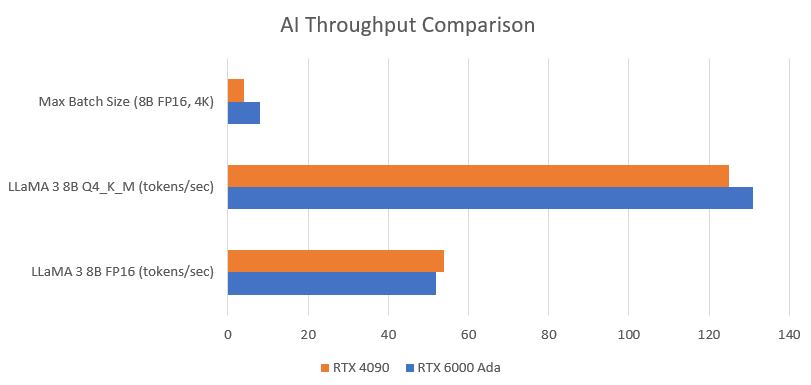
In AI inference tests using the LLaMA 3 8B model, the RTX 6000 Ada and RTX 4090 show notable differences due to their target design and memory capacity. For FP16 precision, the RTX 6000 Ada achieves 51.97 tokens/sec, while the RTX 4090 reaches 52–55 tokens/sec. Although raw throughput is similar, the RTX 6000 Ada’s larger professional memory allows a max batch size of 8, compared to 4 on the RTX 4090, supporting larger AI datasets or multiple simultaneous inference tasks.
The RTX 4090, optimized for consumer workloads, delivers slightly higher peak throughput and excels in single-instance inference, making it ideal for gaming-focused AI projects or individual workstation use. In contrast, the RTX 6000 Ada, a professional GPU designed for AI, HPC, and enterprise applications, provides more memory and better multi-instance support, making it suitable for large-scale AI inference, model testing, or data center deployments.
Overall, choose RTX 4090 for raw single-instance speed, and RTX 6000 Ada for memory-intensive or enterprise-scale AI workloads.
Price & Value: RTX 6000 Ada vs RTX 4090
| Platform / Option | RTX 6000 Ada (USD) | RTX 4090 (USD) |
|---|---|---|
| Official MSRP / Retail GPU | $10,000+ | $1,600–$2,900 |
| Databasemart Hosting | N/A | $549 / month (hosting can save ~50% vs direct GPU purchase) |
| Third-Party Resellers (eBay) | $9,500–$12,000 (eBay) | $1,600–$3,100 (eBay) |
| Other Resellers / Marketplaces | $9,800–$11,500 (Newegg) | $1,700–$2,900 (Newegg)) |
Databasemart GPU Alternatives to RTX 6000 Ada
While Databasemart does not currently offer NVIDIA RTX 6000 Ada servers, we provide several high-performance GPU server options designed for similar workloads. These solutions are suitable for AI training, inference, scientific computing, 3D rendering, and enterprise visualization.
| Model | Best Use Case | GPU | CPU | Memory | Storage | Architecture | FP32 Performance |
|---|---|---|---|---|---|---|---|
| Enterprise GPU VPS – RTX Pro 6000 | High-end AI inference, large dataset training | RTX Pro 6000 96GB GDDR7 |
32 Cores | 90GB | 400GB SSD | GDDR7 / Ada Lovelace | 126 TFLOPS |
| Enterprise GPU Dedicated Server – RTX A6000 | Mature AI workflows, professional visualization | RTX A6000 48GB GDDR6 |
Dual 18-Core E5-2697 v4 | 256GB | 240GB SSD + 2TB NVMe + 8TB SATA | Ampere | 38.71 TFLOPS |
| Multi-GPU Dedicated Server – 3x RTX A6000 | Large-scale rendering, multi-model AI training | 3 x RTX A6000 48GB GDDR6 each |
Dual 18-Core E5-2697 v4 | 256GB | 240GB SSD + 2TB NVMe + 8TB SATA | Ampere | 38.71 TFLOPS per GPU |
| Multi-GPU Dedicated Server – 4x RTX A6000 | Extreme AI workloads, simulation, high-end rendering | 4 x RTX A6000 48GB GDDR6 each |
Dual 22-Core E5-2699 v4 | 512GB | 240GB SSD + 4TB NVMe + 16TB SATA | Ampere | 38.71 TFLOPS per GPU |
Selection Tip:
Choose RTX Pro 6000 VPS if you need the latest architecture with extremely large VRAM for professional AI or inference workloads. Choose RTX A6000 Dedicated Servers if you prefer a mature Ampere ecosystem, higher memory capacity per server, or multi-GPU configurations for large-scale AI and rendering tasks.
Why buy when you can host? RTX 6000 Ada servers aren’t currently available, but you can get similar high-performance GPUs on our Enterprise and Multi-GPU servers with full CPU, RAM, storage, and resources included.
RTX 6000 Ada vs RTX 4090– Pros & Cons
| Model | Pros | Cons |
|---|---|---|
| RTX 6000 Ada |
✅ Massive 96GB GDDR7 memory, ideal for large-scale AI training and enterprise datasets ✅ Optimized for sustained workloads, AI inference, professional rendering, and scientific computing ✅ Transformer Engine + Tensor cores optimized for modern AI workflows, ensuring stable throughput |
❌ Extremely high MSRP (~$10,000+), not suitable for casual use ❌ Limited availability, only via enterprise or server hosting ❌ Lower peak FP32 (~126 TFLOPS per GPU) than RTX 4090 in short-term burst workloads |
| RTX 4090 |
✅ Peak performance for gaming, creative content production, and real-time rendering ✅ Very high FP32 compute (~82 TFLOPS), excellent for short-term AI inference and heavy rendering bursts ✅ Large 24GB GDDR6X memory, sufficient for most creative and AI tasks |
❌ High power consumption (~450 W), requires robust cooling and power supply ❌ Less suited for sustained enterprise AI workloads compared to RTX 6000 Ada ❌ Smaller memory compared to RTX 6000 Ada, may limit extremely large AI models |
High-Performance GPU Server Hosting
Looking for high-performance GPU servers? While NVIDIA RTX 6000 Ada isn’t currently available, Databasemart GPU servers offer powerful alternatives with RTX 4090, giving you remote access to top-tier GPUs without the upfront cost or hassle of buying and maintaining hardware. Our servers feature 99.9% uptime, multi-core CPUs, and high-speed SSD storage, ensuring smooth performance for gaming, AI, rendering, and creative workloads.
Compared to local workstations, hosting an RTX 4090 GPU server saves on electricity, cooling, and maintenance, while providing scalable resources and remote access—perfect for freelancers, studios, or AI developers.
Not sure which GPU server fits your workload?
👉 Browse our full GPU server lineup and select the option that best suits your needs.
Conclusion
In summary, each GPU targets a distinct workload. The RTX 6000 Ada excels in large-scale AI training, professional rendering, and enterprise-level simulations, offering massive VRAM and sustained performance for complex datasets. The RTX 4090 delivers peak performance for gaming, creative content production, and real-time rendering, with very high FP32 throughput and ample memory for most AI and visualization tasks.
While we don’t currently offer RTX 6000 Ada servers, Databasemart provides powerful alternatives with RTX 4090 GPU servers, allowing you to scale resources remotely without the upfront cost or maintenance of high-end hardware. Your choice should depend on whether you prioritize enterprise-level sustained performance or peak creative and AI throughput, and our team can help you select the optimal solution for your workload.
rtx 6000 ada vs rtx 4090, rtx 6000 ada specs, rtx 6000 ada vs 4090, rtx 4090 benchmark, rtx 4090 price, nvidia 4090 price, 4090 rtx price, 4090 benchmark, RTX 6000 Ada vs RTX 4090