Client Load Balancer Server 1 Server 2 Server 3 Traffic Distribution NLB Core health check Active NLB Standby NLB automatic failover
Network Load Balancing

Network Load Balancing

Network Load Balancing (NLB) distributes traffic across multiple hosts to improve scalability and availability of IP-based services. It detects failures and automatically reroutes traffic to healthy servers.

Why Choose Us

Benefits of Network Load Balancing

Scalability

Network Load Balancing improves server performance by distributing client requests across multiple servers, allowing easy scaling by adding more servers as traffic grows.

High availability

Network Load Balancing ensures high availability by detecting server failures and redistributing traffic to remaining servers within seconds, maintaining uninterrupted service.

Manageability

Manage multiple NLB clusters and hosts from a single system using NLB Manager or PowerShell cmdlets.

HA Database Solution

Network Load Balancing Solutions

Please contact us for a quote based on your needs.

load balancing

Solution 1 - IIS ARR + Microsoft NLB + IIS

Making IIS website Highly Available using IIS ARR and Microsoft NLB. Applies to: Windows Server 2025/2022/2019/2016, IIS 7.0 and above.

Example of implementation
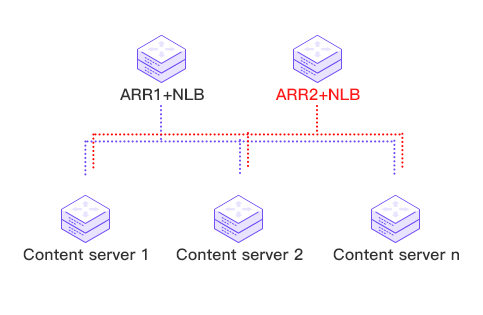
Configure ARR1+NLB, ARR2+NLB to be Windows Load Balancing servers, which provides high availability and scalability for the content servers. ARR is built as a module on top of IIS and is designed to make the routing decisions at layer 7 (application). NLB makes the routing decisions at layer 3.

load balancing

Solution 2 - LVS/HAProxy + Keepalived + Nginx

Making Nginx website Highly Available using LVS/HAProxy and Keepalived. Applies to: CentOS 8.x/7.x, Ubuntu 20.x/18.x LTS

Implementation example
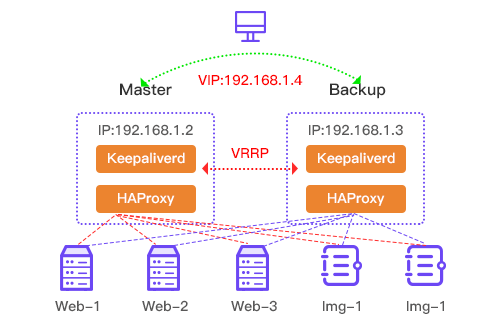
Prepare 7 CentOS 7.x hosts and a virtual IP(VIP) address: 192.168.1.4
The load balancer will use 2 hosts, one primary and one standby
lb1 (default primary): 192.168.1.2
lb2 (default standby): 192.168.1.3
The back-end web servers powered by nginx
web servers: Web-1 Web-2 Web-3
image servers: Img-1 Img-2

FAQ

Network Load Balancing FAQs

Frequently asked questions about HNetwork Load Balancing service.

Network Load Balancing (NLB) distributes traffic across multiple servers to prevent overload and improve performance.
Use NLB for high or spiky traffic, static or elastic IP needs, and multi-port or container-based applications.
Application Request Routing (ARR) is an IIS feature used for load balancing across servers with a user-friendly interface, often combined with NLB for high availability.
LVS is an open-source load balancing project for Linux that provides high performance, scalability, and reliability using clustering technology.
NLB uses TCP/IP to distribute incoming traffic across multiple servers in a cluster, improving reliability and performance.
It prevents server overload, improves performance and availability, and ensures fast and reliable request handling.
HAProxy is a fast, reliable open-source load balancer and reverse proxy widely used for high-traffic TCP and HTTP applications.
Resources

Related Articles

Useful Resources about our NLB service.

Network Load Balancing

In this topic, we provide you with an overview of the Network Load Balancing (NLB) feature in Windows Server 2016. You can use NLB to manage two or more servers as a single virtual cluster. NLB enhances the availability and scalability ...

Read More →
Windows Clustering and High-Availability

Windows Server 2019 Failover Clustering New Features. John Marlin on May 13 2019 03:10 PM. This blog ...

Read More →
Network Load Balancing Deployment Guide

Applies To: Windows Server 2008, Windows Server 2008 R2, Windows Server 2012 Network Load Balancing (NLB) is an optional component...

Read More →
Build a Web Farm with IIS Servers

This scenario shows how to plan and configure a web farm with servers that run the Windows Server® 2012 operating system. The scenario is divided into two phases: a plan and design phase...

Read More →
Failover Clustering in Windows Server and Azure Stack HCI?

A failover cluster is a group of independent computers that work together to increase the availability and scalability of clustered roles...

Read More →
Catalyst Switches for Microsoft Network Load Balancing Configuration Example

The information in this document was created from the devices in a specific lab environment. All of the devices used in this document started with ...

Read More →