


GTX 1660 Ti vs 1070: Is There a Real Difference?
While NVIDIA’s RTX series now dominates professional workloads, older GTX cards like the 1070 and 1660 Ti still hold relevance for AI development, video editing, live streaming, and 3D rendering. Many content creators and developers revisit these GPUs due to their affordability and solid performance in productivity tasks. The GTX 1070 offers higher raw power and larger memory capacity, suitable for GPU-heavy rendering or medium AI models. Meanwhile, the GTX 1660 Ti benefits from a newer architecture, lower power consumption, and stable performance in modern workloads.
In this article, we will examine how these two GPUs truly compare today by looking at real-world performance, gaming benchmarks, pricing trends, and user feedback to determine which one still offers the best value.
Summary of GTX 1070 vs GTX 1660ti
The GTX 1660 Ti and GTX 1070 are two notable GPUs from NVIDIA’s past lineups, each bringing its own innovations to the table. The GTX 1070 offers higher raw performance and 1440p support, making it suitable for compute-heavy tasks. The GTX 1660 Ti features a newer architecture with better energy efficiency, optimized for modern software. Both GPUs also support productivity workloads like AI inference, video editing, live streaming, and 3D rendering, making them attractive for creators on a budget.
Positioning:
- GTX 1070: High-end card aimed at players seeking strong performance without stepping into the RTX series.For productivity users, it is suitable for GPU-heavy rendering, larger video projects, and medium-scale AI workloads.
- GTX 1660 Ti: Mid-range option designed for efficient, smooth 1080p gaming.In professional tasks, it excels in energy-efficient AI inference, real-time video streaming, and 1080p–1440p rendering workflows.
Shared Advantages:
- Productivity & Gaming Performance: Both support CUDA, OpenCL, and other frameworks. GTX 1070 excels in compute-heavy tasks, while GTX 1660 Ti is efficient and stable for modern workloads.
- Reliability & Driver Support: Mature drivers and broad ecosystem support ensure reliable performance for long AI training sessions, video rendering, and live streaming.
- Energy & Efficiency: GTX 1660 Ti has lower power consumption, suitable for long workloads. GTX 1070 provides higher peak performance and larger VRAM.
With these points in mind, this article will take a closer look at how the GTX 1660 Ti and GTX 1070 compare in real-world performance, gaming benchmarks, and current value, helping you decide which one suits your needs today.
GTX 1070 vs GTX 1660 Ti: Launch Background Comparison
| Feature / Aspect | GTX 1070 | GTX 1660 Ti |
|---|---|---|
| Launch Date | June 2016 | February 2019 |
| Architecture | Pascal | Turing (without RT cores) |
| Target Market | High-end gamers, 1440p gaming | Mid-range gamers, 1080p optimized |
| Launch Price | ~$379 USD | ~$279 USD |
| Notable Innovation | Strong raw performance for its time, excellent 1440p capability | Newer architecture, better energy efficiency, modern game optimizations |
| Target Customer | Gamers seeking higher resolution and raw performance | Gamers looking for efficiency and modern 1080p experience |
From their release backgrounds, the GTX 1070 and GTX 1660 Ti clearly target different audiences.
The GTX 1070 focused on high-end performance, higher-resolution gaming, and raw computational power, making it the ideal choice for demanding users in 2016.
Three years later, the GTX 1660 Ti was released, emphasizing energy efficiency, modern architecture, and smooth 1080p performance, catering to mid-range users seeking a balance between performance and efficiency.
GTX 1070 vs 1660 Ti Specifications
| Parameter | GTX 1070 | GTX 1660 Ti |
|---|---|---|
| GPU Model | GP104 (Pascal) | TU116 (Turing) |
| Architecture | Pascal | Turing |
| CUDA Cores | 1920 | 1536 |
| Memory Type | GDDR5 | GDDR6 |
| Memory Capacity | 8 GB | 6 GB |
| Memory Bandwidth | ~256.3 GB/s | ~288 GB/s |
| Core Frequency (Base / Boost) | 1506 / 1683 MHz | 1500 / 1770 MHz |
| TDP | 150 W | 120 W |
| Interface / PCIe Bus | PCIe 3.0 x16 | PCIe 3.0 x16 |
| FP32 Performance (Theoretical) | ~6.5 TFLOPS | ~5.4 TFLOPS |
| PCIe Version | PCIe 3.0 | PCIe 3.0 |
Looking at the core specifications, it’s clear that each GPU has its own advantages, catering to different types of users.
The GTX 1070, with its higher CUDA core count and 8 GB of GDDR5 memory, delivers impressive raw performance. This makes it a solid choice for high-resolution gaming (such as 1440p) and GPU-intensive tasks like 3D rendering or simulation software. Its theoretical FP32 performance of around 6.5 TFLOPS further highlights its ability to handle demanding workloads.
In contrast, the GTX 1660 Ti features newer GDDR6 memory with higher bandwidth (~288 GB/s) and a slightly higher boost clock (1770 MHz), while maintaining a lower TDP of 120 W. This makes it more energy-efficient and thermally optimized, ideal for modern 1080p–1440p workflows, including AI inference, video rendering, and live streaming, where smooth performance and lower power consumption are important.
Understanding these specifications helps users make more informed decisions, whether choosing a GPU for gaming, content creation, AI development, or rendering workloads, ensuring the card matches their performance and efficiency requirements.
GTX 1660 Ti vs 1070: Performance Across Different Scenarios
Gaming Performanc
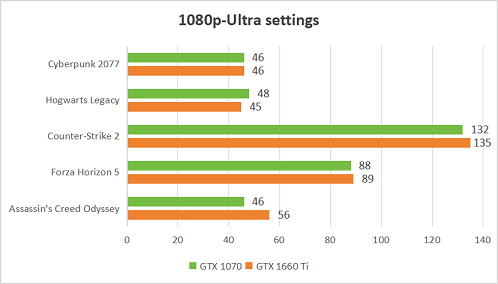
At 1080p Ultra, the GTX 1660 Ti generally performs slightly better in demanding AAA titles. For example, it achieves 56 FPS in Assassin's Creed Odyssey, compared to 46 FPS on the GTX 1070. In other games like Forza Horizon 5 and Counter-Strike 2, the differences are smaller, but the 1660 Ti still shows slightly smoother frame rates. This suggests that at 1080p Ultra settings, the 1660 Ti is more efficient in modern games, while the 1070 retains strong raw power.
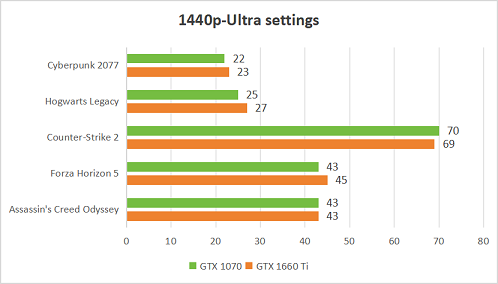
At 1440p Ultra, the GTX 1660 Ti maintains a slight advantage in most games. Titles like Forza Horizon 5, Hogwarts Legacy, and Cyberpunk 2077 see higher FPS on the 1660 Ti, providing smoother gameplay. The GTX 1070 still performs well, especially in competitive games like Counter-Strike 2, but in AAA open-world titles, the 1660 Ti’s modern memory and efficiency give it a subtle edge.
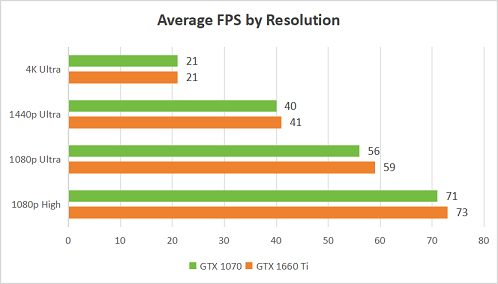
Looking at the overall averages, the GTX 1660 Ti consistently provides slightly higher frame rates at 1080p Ultra and 1440p Ultra. Both GPUs perform well at 1080p High, but struggle at 4K Ultra with only 21 FPS. This highlights that neither card is suitable for 4K high-end gaming, yet at 1080p and 1440p, the 1660 Ti is more efficient and optimized for modern titles, while the GTX 1070 still offers solid performance for users who prioritize raw power and higher memory capacity.
From these three perspectives — 1080p Ultra, 1440p Ultra, and average FPS — we can see a consistent pattern: the GTX 1660 Ti offers slightly better efficiency and smoother frame rates in modern games, particularly for 1080p and 1440p. The GTX 1070, while slightly behind in certain modern titles, still has raw computational strength and larger memory, making it a viable option for high-resolution gaming and older titles.
3DMark Synthetic Benchmark Results
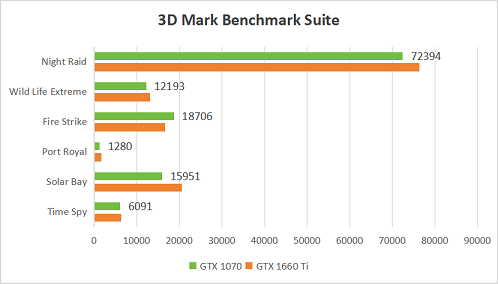
We continue to look at the two graphics cards in 3DMark synthetic benchmarks, which measure raw performance, memory bandwidth, and ray-tracing. The comparison shows clear differences under modern workloads:
Solar Bay (+29%) and Port Royal (+29%) highlight the GTX 1660 Ti’s advantage in memory and ray-tracing performance.
Time Spy (+4%), Wild Life Extreme (+7%), and Night Raid (+5%) also slightly favor the 1660 Ti, showing stable performance.
The GTX 1070, however, performs better in older, compute-heavy tests like Fire Strike (-11%), thanks to more CUDA cores and larger memory.
Overall, these benchmark results echo the real-game FPS comparisons discussed earlier, showing that the GTX 1660 Ti is more efficient in modern gaming scenarios, while the GTX 1070 remains competitive in tasks that demand high raw computing power.
Artificial Intelligence Tests
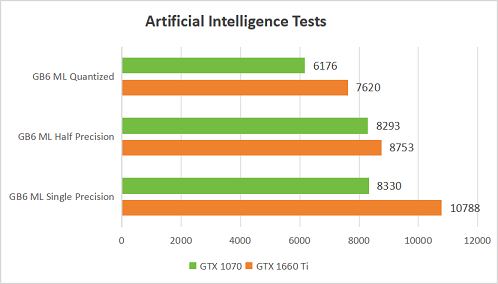
In artificial intelligence benchmarks, the two GPUs demonstrate distinct performance patterns.
- In Single Precision, the GTX 1660 Ti scores 10,788, approximately 29.5% higher than the GTX 1070, showing an advantage in high-precision tasks.
- In Half Precision, the difference is minimal at around 5.5%, indicating similar performance for lighter workloads.
- For Quantized operations, the 1660 Ti leads by 23.4%, handling low-precision inference tasks more efficiently.
Along with the previous FPS and 3DMark results, this data further illustrates the performance differences between the two GPUs in modern workloads, providing users with clearer guidance for choosing a graphics card that fits their needs.
GTX 1070 vs 1660 Ti — User Recommendation & Value Analysis
| GPU Model | Original MSRP | eBay Used Price |
|---|---|---|
| GTX 1070 | US $379 | ~ US $75 – 120 |
| GTX 1660 Ti | US $279 | ~ US $80 – 100 |
The GTX 1660 Ti launched at a significantly lower price than the GTX 1070, but with the arrival of the RTX series, both cards have become older models. Today, their prices on the second-hand market are quite similar. Therefore, if you are looking for “lower cost + stable performance + a newer architecture,” the GTX 1660 Ti offers better value. However, in terms of peak performance and VRAM capacity, the GTX 1070 is more suitable for medium to high workloads or higher-resolution gaming, making it a solid choice for those needs.
GTX 1070 vs GTX 1660Ti: Pros & Cons
| GPU | Advantage | Disadvantage |
|---|---|---|
| GTX 1660 Ti | ✅Modern Turing architecture ✅Lower power consumption ✅Solid 1080p–1440p gaming ✅Good cost-performance ✅GDDR6 memory |
❌6 GB VRAM may limit some games ❌Lower peak raw performance ❌Fewer CUDA cores for compute |
| GTX 1070 | ✅Higher peak performance ✅8 GB VRAM ✅Strong raw computing power ✅Mature drivers & compatibility |
❌Older Pascal architecture ❌Higher power consumption ❌Less cost-effective ❌Memory bandwidth slightly weaker |
Conclusion
In conclusion, the GTX 1660 Ti and GTX 1070 show relatively close performance overall, with each excelling in different areas. The GTX 1660 Ti offers a newer architecture, better efficiency, and excellent value for 1080p–1440p gaming, while the GTX 1070 provides higher peak performance and more VRAM, making it suitable for higher-resolution gaming or more demanding workloads.
For players whose budget does not allow for the newer RTX series, either card remains a solid choice: the 1660 Ti is ideal for cost-conscious gamers seeking efficiency and stable performance, while the 1070 is better for those who prioritize raw power and extra memory capacity.
GTX 1660 Hosting
Based on our analysis of the GTX 1070 vs GTX 1660 Ti, for content creators and developers who prioritize cost and efficiency, Database Mart’s GTX 1660 GPU server hosting is an excellent alternative. The GTX 1660 consumes slightly less power (~120 W), is energy-efficient and stable, and provides enough performance to handle AI inference, video rendering, 3D rendering, and live streaming. For detailed benchmarks and server options, see: Ollama GPU Benchmark - GTX1660
Hosting a GTX 1660 GPU with Database Mart allows content creators and developers to access high-performance, stable, and energy-efficient computing resources at a lower cost, while easily managing AI workloads, video and 3D rendering, and live streaming. It’s an ideal solution to boost productivity and efficiency. If you’re interested, you can click the link below to explore Database Mart’s GPU Server Hosting and learn more!
1070 vs 1660 ti, gtx 1070 vs gtx 1660ti, 1070 price, gtx 1660 ti price, 1660ti vs1070, gtx 1660 ti benchmark, gtx 1070 benchmark, gtx 1660 ti vs 1070