


NVIDIA RTX A6000 vs A5000: Which Is Worth Buying in 2025?
This comparison breaks down the key differences between NVIDIA RTX A6000 and RTX A5000, focusing on core performance, VRAM capacity, and real-world professional workloads. The RTX A6000 delivers significantly higher compute power and a massive 48 GB of VRAM, making it ideal for large-scale rendering, AI training, and complex simulations. The RTX A5000, with 24 GB of VRAM, offers a more cost-efficient solution for advanced 3D design, video production, and mid-to-high intensity professional tasks. This guide helps you determine which GPU best fits your workflow and budget.
NVIDIA A6000 vs A5000 – Background Comparison
| Brand | Series | Model | Release Year | Official Positioning / Description | Market Price (USD) |
|---|---|---|---|---|---|
| NVIDIA | RTX A Series | A6000 | 2020 | The NVIDIA RTX™ A6000 is a flagship professional GPU for desktop workstations, offering 48 GB ECC GDDR6 memory, Ampere-based compute, advanced ray tracing, AI acceleration, and NVLink scalability for large-scale rendering, simulation, and memory-intensive professional workloads. | ~$4,110 |
| NVIDIA | RTX A Series | A5000 | 2021 | The NVIDIA RTX™ A5000 is a balanced professional workstation GPU built on the Ampere architecture, offering reliable performance, power efficiency, and 24 GB of ECC GDDR6 memory for advanced design, rendering, engineering, and AI workloads. | ~$2,250 |
NVIDIA A6000 vs A5000 – Specifications Comparison
Core Specs Comparison
| Parameter | A6000 | A5000 | Difference / Advantage |
|---|---|---|---|
| Architecture | Ampere | Ampere | Both use Ampere; A6000 optimized for maximum professional graphics performance |
| CUDA Cores | 10,752 | 8,192 | A6000 has more CUDA cores, offering higher parallel compute for rendering, simulation, and AI-augmented workflows |
| Tensor Cores | 336 | 256 | A6000 has more Tensor Cores, providing faster AI acceleration and machine learning performance |
| Memory Type | GDDR6 | GDDR6 | Both use GDDR6; A6000 supports larger memory configurations for bigger datasets |
| Memory Capacity | 48 GB | 24 GB | A6000 has double the VRAM, ideal for large models, complex scenes, and memory-intensive professional tasks |
| Memory Bus | 384-bit | 384-bit | Same bus width; A6000 benefits from more memory capacity per channel |
| Memory Bandwidth | 768 GB/s | 768 GB/s | Bandwidth is the same, but A6000’s larger memory improves handling of massive workloads |
| FP32 Performance | ~38.7 TFLOPS | ~27.77 TFLOPS | A6000 delivers higher FP32 performance for graphics and compute-heavy workloads |
| TDP (Power) | 300 W | 230 W | A6000 provides more performance at slightly higher power, maintaining efficiency for workstation setups |
| Interface / Bus | PCIe 4.0 x16 | PCIe 4.0 x16 | Both support PCIe 4.0; no difference in interface speed |
Key Differences: NVIDIA RTX A6000 vs A5000
Memory & Large Workloads: A6000’s 48 GB VRAM vs A5000’s 24 GB allows working with much larger 3D models, high-resolution textures, and complex simulations without hitting memory limits.
Rendering & Compute Speed: A6000’s higher CUDA and Tensor cores provide faster rendering, simulation, and AI tasks; A5000 may slow down on very heavy workloads.
AI & Machine Learning: A6000 handles larger AI models and training datasets efficiently, while A5000 is better suited for moderate AI tasks.
Multi-Tasking & Scalability: A6000 supports more simultaneous heavy workloads and scales better in multi-GPU setups; A5000 is limited for extremely large or parallelized projects.
Sustained Performance: A6000 can maintain peak performance longer under high load, whereas A5000 may throttle earlier under very demanding tasks.
RTX A6000 vs RTX A5000 Performance Across Different Scenarios
3D Rendering
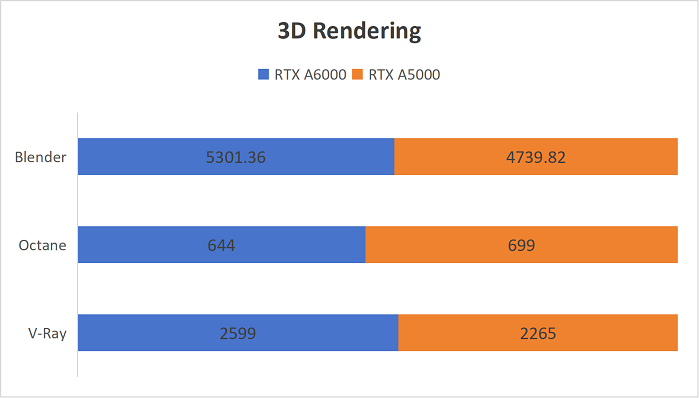
Professional 3D rendering workloads demand high GPU performance, large memory capacity, and efficient compute capabilities. Applications like V-Ray, Octane, and Blender provide a practical measure of a graphics card’s ability to handle complex scenes, high-resolution textures, and intensive ray-tracing calculations. Comparing RTX A6000 and RTX A5000 across these rendering engines highlights how each card performs under real-world professional scenarios.
Summary:
V-Ray Performance: RTX A6000 (2599) outperforms A5000 (2265), making it better for complex, memory-intensive scene rendering.
Octane Performance: RTX A5000 (699) slightly surpasses A6000 (644), showing engine-specific optimizations can favor different architectures.
Blender Performance: RTX A6000 (5301.36) leads A5000 (4739.82), reflecting higher cores and larger memory for demanding animations and high-resolution projects.
Overall Implication: A6000 is ideal for high-end professional 3D workflows requiring maximum memory and compute power, while A5000 is suitable for mid-range workloads and moderately complex scenes.
Gaming Performance
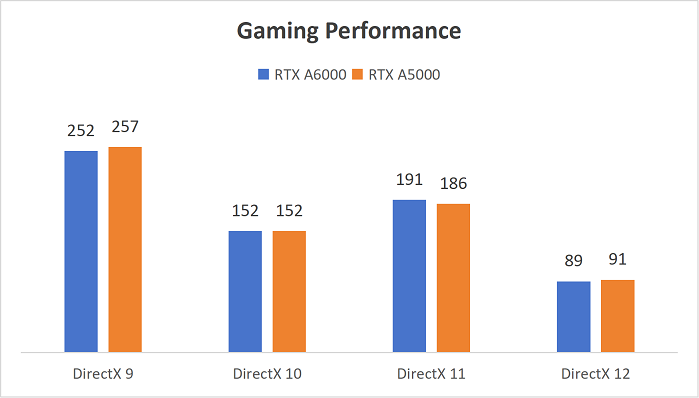
Gaming performance depends on a GPU’s ability to render frames smoothly across different DirectX APIs, which represent the graphics engines used in modern games. Comparing RTX A6000 and RTX A5000 across DirectX 9, 10, 11, and 12 provides insight into how each card handles legacy titles, contemporary games, and the latest DirectX 12 features, reflecting real-world gaming frame rates and responsiveness.
Summary:
DirectX 9 & 10: Both cards deliver nearly identical performance (A6000: 252/152 FPS, A5000: 257/152 FPS), showing similar capabilities for older or mid-tier games.
DirectX 11: A6000 slightly outperforms A5000 (191 vs 186 FPS), offering smoother frame rates in modern titles.
DirectX 12: A5000 marginally leads (91 vs 89 FPS), indicating that certain modern engine optimizations may favor its architecture.
Overall Implication: Both cards are capable of handling gaming workloads, but neither is specifically optimized for gaming. Differences are minimal, making the A5000 slightly more cost-efficient for gaming, while the A6000 is better suited for professional workloads.
Combined Synthetic Benchmark Score
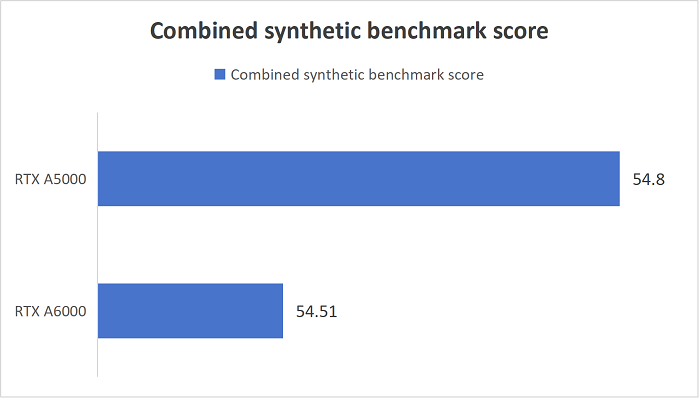
Synthetic benchmarks provide a standardized way to compare overall GPU performance across different workloads, combining graphics, compute, and memory tests into a single score. The combined synthetic benchmark score allows for a high-level assessment of the RTX A6000 and A5000, offering insight into their general-purpose capabilities beyond specific applications like gaming or 3D rendering.
This is our combined benchmark score.
Summary:
Overall Score: The A5000 slightly leads with 54.8 compared to A6000’s 54.51, indicating near-identical performance in a broad, mixed workload scenario.
Implication: For general-purpose GPU tasks that blend compute, rendering, and graphics, both cards deliver comparable performance.
Decision Insight: The choice between A6000 and A5000 should be guided more by specific professional workloads (e.g., large-scale 3D rendering or AI) rather than general synthetic benchmark differences.
Price & Value: NVIDIA RTX A6000 vs A5000
| Platform | RTX A6000 (USD) | NVIDIA A5000 (USD) | Price Difference: A100 vs A6000 (%) |
|---|---|---|---|
| Official MSRP | $4,110 | $2,250 | +83% |
| Amazon | $4,500–$5,200 | $2,200-2,999 | +73–136% |
| Third-Party Resellers (eBay etc.) | $4,200–$5,000 | $3,680–$5,250 | -5–14% |
Value Analysis: RTX A6000 vs RTX A5000
RTX A6000: With an MSRP of $4,110 (often $4,500–$5,200 retail), the A6000 delivers maximum GPU memory, more CUDA/Tensor cores, and top-tier 3D rendering and AI performance. Ideal for large-scale projects and demanding professional workloads, its high price is justified by future-proofed capabilities.
RTX A5000: Priced around $2,200–$3,000, the A5000 offers strong performance for mid-range professional tasks like CAD, real-time visualization, smaller AI models, and moderate rendering workloads. Its price-to-performance ratio is much higher for users who don’t need extreme memory or compute power.
Conclusion:
Choose the RTX A6000 for maximum performance and large-scale professional workflows. Opt for the RTX A5000 for a cost-effective, balanced solution that handles most professional tasks efficiently without the premium price.
NVIDIA RTX A6000 vs NVIDIA A5000 – Pros & Cons
| Model | Pros | Cons |
|---|---|---|
| RTX A6000 | ✅ Excellent 3D rendering performance (Blender, V-Ray, Octane) | ❌ High price ($4,500–$5,200) |
| ✅ 48 GB VRAM, ideal for large scenes and complex models | ❌ Overkill for mid-range workloads | |
| ✅ Optimized CUDA and RT cores for professional graphics and visualization tasks | ❌ Not as cost-efficient for moderate projects | |
| RTX A5000 | ✅ Strong performance for mid-range 3D rendering and visualization | ❌ Lower VRAM (24 GB) limits very large scenes |
| ✅ More affordable ($2,200–$3,000) | ❌ Fewer CUDA/Tensor cores than A6000 | |
| ✅ Efficient for CAD, real-time visualization, and smaller AI tasks | ❌ Less suitable for large-scale AI training or memory-intensive workloads |
A6000 & A5000 Server Hosting
GPU server hosting allows professionals and enterprises to access high-performance GPUs without investing in physical hardware, providing flexibility, scalability, and cost efficiency for demanding workflows.
RTX A5000 Hosting
The RTX A5000 is ideal for mid-range professional workloads. With 24 GB of VRAM, it handles CAD, real-time visualization, smaller AI inference, and moderate 3D rendering efficiently. Hosting solutions featuring the A5000 offer reliable performance at a lower cost, making it suitable for teams or projects with moderate resource requirements.
RTX A6000 Hosting
For high-end workloads, the RTX A6000 delivers 48 GB of VRAM, additional CUDA/Tensor cores, and NVLink support for multi-GPU scalability. Hosted A6000 servers excel at large-scale 3D rendering, complex simulations, animation, and AI training, providing the power needed for memory-intensive and compute-heavy projects.
With platforms like Database Mart offering both A5000 and A6000 hosting options, users can select the GPU tier that fits their workload—starting with the A5000 for moderate projects and scaling up to A6000 for demanding, high-performance tasks—ensuring professional flexibility and cost-effective resource management.
Conclusion
The RTX A6000 is the ultimate choice for professionals tackling high-end 3D rendering, complex animations, large-scale AI and deep learning models, or scientific simulations that demand extensive memory and raw performance. On the other hand, the RTX A5000 offers a balanced and efficient solution for mid-range professional workloads, including CAD, real-time visualization, and smaller-scale AI tasks. In short, the A6000 excels when maximum power and capacity are essential, while the A5000 delivers strong performance for users with moderate requirements, making it a cost-effective yet capable option.
a5000 vs a6000, a6000 vs a5000, rtx a5000 price, a6000 price, a6000 specs, nvidia a5000, nvidia a6000, gpu comparison, a5000 gpu, gpu benchmark