


NVIDIA A6000 vs A100: Which GPU Delivers Better Value and Performance
The NVIDIA A6000 and A100 are professional GPUs built for different needs. The A6000 focuses on large VRAM and versatility, making it suitable for rendering, visualization, and AI inference. The A100 delivers much higher compute power for AI training and data center workloads. In 2025, the choice comes down to flexibility and value (A6000) versus maximum AI performance (A100)
Summary Light of A6000 & A100
Key Features: A6000 offers large VRAM and versatile performance for rendering, AI inference, and professional workloads. A100 delivers higher Tensor performance for AI training and data center computing.
Industries: AI research, deep learning, HPC, 3D rendering, visualization, and enterprise GPU servers.
Popular Software: TensorFlow, PyTorch, CUDA apps, Blender, Unreal Engine, Unity, AutoCAD, SolidWorks, NVIDIA Omniverse.
NVIDIA A6000 vs A100 – Background Comparison
The NVIDIA A6000 focuses on large VRAM and versatile performance for professional workloads like 3D rendering, visualization, and AI inference. The A100 delivers significantly higher Tensor Core performance, optimized for AI training, deep learning, and data center computing.
| Brand | Series | Model | Release Year | Official Positioning / Description | Market Price (USD) |
|---|---|---|---|---|---|
| NVIDIA | RTX A Series | A6000 | 2020 | Professional GPU / large VRAM (48GB GDDR6 ECC, 10752 CUDA cores) for rendering, AI inference, and workstation tasks | ~$4,500–$5,000 |
| NVIDIA | A100 Series | A100 | 2020 | Data center GPU / high-performance AI training (40GB HBM2e, 6912 CUDA cores, 432 Tensor cores) | ~$11,000–$12,000 |
NVIDIA A6000 vs A100 – Specifications Comparison
Core Specs Comparison
| Parameter | A6000 | A100 | Difference / Advantage |
|---|---|---|---|
| Architecture | Ampere | Ampere | Both Ampere, but A100 optimized for data center & AI workloads |
| CUDA Cores | 10,752 | 6,912 | A6000 more cores for versatile workloads; A100 has Tensor cores for AI |
| Tensor Cores | 336 | 432 | A100 much stronger for AI training and HPC tasks |
| Memory Type | GDDR6 ECC | HBM2e | A100 uses HBM2e for higher bandwidth |
| Memory Capacity | 48 GB | 40 GB | A6000 more VRAM, better for large models and visualization |
| Memory Bus | 384-bit | 5120-bit | A100 has much wider memory bus for high-throughput AI workloads |
| Memory Bandwidth | 768 GB/s | 1,555 GB/s | A100 ~2× higher bandwidth |
| FP32 Performance | ~38.7 TFLOPS | ~19.5 TFLOPS (FP32) / 312 TFLOPS (Tensor) | A6000 better at general FP32; A100 excels in Tensor ops |
| TDP (Power) | 300W | 400W | A6000 more power-efficient |
| Interface / Bus | PCIe Gen4 ×16 | PCIe Gen4 ×16 / SXM4 | Same PCIe interface |
| Target Workloads | Workstations, AI inference, 3D rendering | AI training, HPC, data centers | Choice depends on flexibility (A6000) vs max AI performance (A100) |
Advanced Features Comparison
| Feature / Capability | A6000 | A100 | Difference / Advantage |
|---|---|---|---|
| AI Acceleration | CUDA + Tensor cores | CUDA + Tensor cores + Mixed Precision | A100 optimized for large-scale AI training |
| Ray Tracing / Rendering | Yes | Limited / data center focused | A6000 better for visualization and professional rendering |
| Multi-GPU NVLink Support | Yes | Yes | Both support NVLink for scaling |
| VRAM Advantage | 48GB GDDR6 ECC | 40GB HBM2e | A6000 better for very large datasets in workstations |
| Target Industries | Workstations, Media & Entertainment, AI inference, 3D rendering | AI research, HPC, Data Centers | A6000 for versatility; A100 for high-end AI/HPC |
| Popular Software | Blender, Unreal Engine, Unity, AutoCAD, SolidWorks, Omniverse, TensorFlow (GPU), PyTorch (GPU) | TensorFlow (GPU), PyTorch (GPU), HPC frameworks, CUDA libraries | A100 specialized for deep learning / HPC, A6000 more versatile |
The NVIDIA A6000 focuses on large VRAM and balanced performance for workstations, AI inference, 3D rendering, and professional workloads. The A100 provides much higher Tensor Core performance, optimized for large-scale AI training, deep learning, and HPC data center tasks. In 2025, the choice comes down to flexibility and VRAM-heavy professional workloads (A6000) versus maximum AI training performance and data center scalability (A100).
RTX A6000 vs A100 Benchmark: Performance Across Different Scenarios
AI Performance
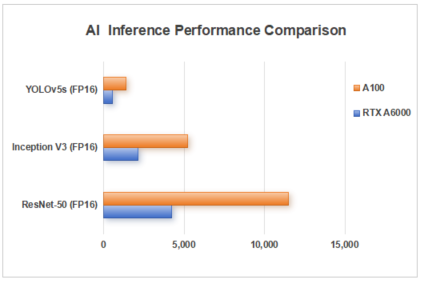
The NVIDIA A100 outperforms the RTX A6000 in FP16 inference across common AI models. For ResNet-50, A100 achieves 11,500 vs 4,200 images/sec; for Inception V3, 5,200 vs 2,100 images/sec; and for YOLOv5s, 1,400 vs 550 images/sec. While the A6000 handles smaller workloads well, the A100 is clearly better for high-throughput AI inference.
Price & Value: NVIDIA RTX A6000 vs A100
| Platform | RTX A6000 (USD) | NVIDIA A100 (USD) | Price Difference: A100 vs A6000 (%) |
|---|---|---|---|
| Official MSRP | $4,650 | $11,000–$12,000 | +137–158% |
| Amazon / Enterprise Resellers | $4,500–$5,200 | $10,500–$12,500 | +133–140% |
| Secondary / Gray Market | $4,200–$5,000 | $9,500–$12,000 | +125–140% |
The NVIDIA A100 costs roughly 1.3–1.6× more than the RTX A6000, depending on the seller, but it is specialized for AI, HPC, and large-scale compute workloads.
For workstation graphics, rendering, and tasks that benefit from CUDA + RT cores (e.g., Blender, V-Ray, Octane), the A6000 offers better price-to-performance value, while the A100 justifies its high price only for AI/HPC workloads.
Summary:
- RTX A6000 → better value for professional rendering and workstation tasks.
- A100 → premium choice for AI/deep learning and HPC applications.
NVIDIA RTX A6000 vs NVIDIA A100 – Pros & Cons
| Model | Pros | Cons |
|---|---|---|
| RTX A6000 | ✅ Excellent GPU rendering performance (Blender, V-Ray, Octane) | ❌ Lower AI / deep learning performance compared to A100 |
| ✅ 48 GB VRAM and full graphics/display support | ❌ High price ($4,500–$5,200) | |
| ✅ Optimized CUDA + RT cores for workstation graphics and rendering tasks | ❌ Not ideal for large-scale HPC or AI compute workloads | |
| A100 | ✅ Exceptional AI / deep learning and HPC performance | ❌ Extremely expensive ($10,500–$12,500) |
| ✅ High memory bandwidth and Tensor cores for large models | ❌ No display outputs / not optimized for GPU rendering | |
| ✅ Great for large-scale compute, scientific simulations, and data-center tasks | ❌ Slower than A6000 for professional GPU rendering tasks (Cycles, V-Ray, Octane) |
RTX A6000 & A100 Hosting
The RTX A6000 Server provides cloud or dedicated GPU instances powered by RTX A6000 GPUs, giving remote access to professional-grade graphics and rendering performance without purchasing physical hardware. Database Mart’s RTX A6000 server features dual Intel Xeon CPUs, 128–256 GB RAM, fast SSD storage, and 99.9% uptime, ideal for Blender, V‑Ray, Octane, 3D modeling, rendering, and other GPU-accelerated creative workloads. With flexible pricing and 24/7 technical support, it provides stable, high-performance GPU access for freelancers, studios, and professionals.
The NVIDIA A100 Server delivers cloud or dedicated GPU instances powered by NVIDIA A100 GPUs, offering world-class AI, deep learning, and HPC performance without the upfront investment of local hardware. Database Mart’s A100 server features dual Intel Xeon CPUs, 128–256 GB RAM, high-speed SSD storage, and 99.9% uptime, perfect for neural network training, inference, scientific simulations, and massive parallel compute workloads. With scalable resources and 24/7 technical support, it provides reliable remote access to top-tier compute power for developers and researchers.
Conclusion
Overall, the RTX A6000 vs NVIDIA A100 comparison highlights strong options for different workloads and budgets. The RTX A6000 is ideal for GPU rendering, 3D modeling, and professional creative tasks, offering excellent CUDA/RT core performance, ample VRAM, and support for rendering engines like Blender, V‑Ray, and Octane, making it highly efficient and cost-effective for creative professionals. The NVIDIA A100, however, provides unmatched performance for AI, deep learning, HPC, and large-scale parallel compute tasks, with Tensor cores and high-bandwidth memory, making it the better choice for users requiring maximum compute power, scalability, and remote access for intensive AI or scientific workloads.
a6000 vs a100, a100 vs a6000 price, a100 benchmark, nvidia a6000, a6000 gpu price, a100 gpu