


RX 7600 vs RTX 3060 Ti: Real-World Gaming, AI, and Rendering Performance
Compare the Radeon RX 7600 and RTX 3060 Ti to see which GPU delivers the best combination of gaming performance, AI capability, and 3D rendering power, helping you choose the right card for gaming, content creation, and GPU-accelerated workloads.
RX 7600 vs RTX 3060 Ti– Background Comparison
| Brand | Series | Model | Release Year | Official Positioning | Market Price (USD) |
|---|---|---|---|---|---|
| AMD | Radeon | RX 7600 | 2023 | The Radeon RX 7600 is built on AMD’s RDNA 3 architecture, offering efficient performance for modern gaming and everyday creative tasks. It features updated compute units with improved ray tracing support, high-speed GDDR6 memory, and enhanced power efficiency, delivering smooth 1080p gaming and reliable performance for current titles. | $269 |
| NVIDIA | GeForce | GTX 3060 Ti | 2020 | The GeForce RTX 3060 Ti is powered by NVIDIA’s Ampere architecture, delivering strong performance for modern games and creative workloads. It features 2nd-generation RT Cores and 3rd-generation Tensor Cores for enhanced ray tracing and AI acceleration, along with high-speed memory for smooth 1440p gaming and efficient streaming or content creation. | $399 |
RX 7600 vs RTX 3060 Ti– Specifications Comparison
Core Specs Comparison between RX 7600 vs RTX 3060 Ti
| Specification | RTX 3060 Ti | RX 7600 | RTX 3060 Ti Improvement / Gain |
|---|---|---|---|
| GPU Model | GeForce RTX 3060 Ti | Radeon RX 7600 | — |
| Architecture | Ampere | RDNA 3 | Mature RTX ecosystem |
| CUDA / Stream Cores | 4,864 CUDA Cores | 2,048 Stream Processors | Better CUDA & compute support |
| Memory Type | GDDR6 | GDDR6 | — |
| Memory Capacity | 8 GB | 8 GB | — |
| Memory Bandwidth | ~448 GB/s | ~288 GB/s | ↑ ~56% higher bandwidth |
| Core Frequency (Base / Boost) | ~1410 / 1665 MHz | ~1720 / 2655 MHz | Lower clocks, higher throughput |
| TDP (Power Draw) | 200 W | 165 W | Higher power, stronger sustained load |
| Interface (Bus Width) | 256-bit | 128-bit | ↑ 2× wider memory bus |
| FP32 Performance | ~16.2 TFLOPS | ~21.7 TFLOPS | ↓ Lower raw FP32 |
| Tensor Cores | Yes (3rd Gen) | No | DLSS / AI acceleration advantage |
| PCIe Interface | PCIe 4.0 x16 | PCIe 4.0 x8 | Full bandwidth support |
The main differences between the RTX 3060 Ti and the RX 7600 lie in their design focus. The RTX 3060 Ti offers higher memory bandwidth, a wider memory bus, full PCIe x16 support, and dedicated Tensor Cores, making it better suited for 1440p gaming, ray tracing, and AI-accelerated workloads such as DLSS and CUDA-based applications. The RX 7600, built on a newer RDNA 3 architecture, emphasizes higher clock speeds, lower power consumption, and strong 1080p performance, prioritizing efficiency over advanced AI and ray-tracing features.
Advanced Feature Comparison between RX 7600 vs RTX 3060 Ti
| Feature | RTX 3060 Ti | RX 7600 | RTX 3060 Ti Improvement / Gain |
|---|---|---|---|
| Ray Tracing | 2nd-Gen RT Cores | 2nd-Gen Ray Accelerators | Superior ray tracing performance |
| AI / Upscaling | DLSS with Tensor Cores | FSR (shader-based) | AI-based upscaling with higher image quality |
| Compute Ecosystem | CUDA, OptiX, TensorRT | OpenCL, Vulkan, ROCm | Broader software and professional support |
| Video Encode / Streaming | NVENC (H.264 / HEVC) | AMD VCN (H.264 / HEVC + AV1) | Better integration with OBS, Adobe, and professional tools |
| Target Usage | 1440p gaming, ray tracing, AI & productivity | 1080p gaming, efficiency | Higher performance for high-res gaming and professional workloads |
The main differences between the RTX 3060 Ti and RX 7600 stem from their design focus and architecture. The RTX 3060 Ti’s Ampere architecture includes dedicated Tensor Cores, mature RT Cores, and a robust CUDA ecosystem, enabling superior ray tracing, AI-based upscaling (DLSS), and professional compute workloads. The RX 7600, built on RDNA 3, emphasizes higher clock speeds, lower power consumption, and modern display standards, delivering efficient 1080p gaming but lacking advanced AI acceleration and the mature software ecosystem of NVIDIA.
RX 7600 vs RTX 3060 Ti Performance Across Different Scenarios
Artificial Intelligence Testing
The GeForce RTX 3060 Ti and Radeon RX 7600 are popular options for upper-mainstream gaming and entry-level AI workloads. Geekbench ML offers a standardized benchmark to measure machine-learning performance across single-precision, half-precision, and quantized tasks. Comparing these two GPUs highlights differences in architectural efficiency, compute throughput, and overall suitability for AI inference and GPU-accelerated workloads.
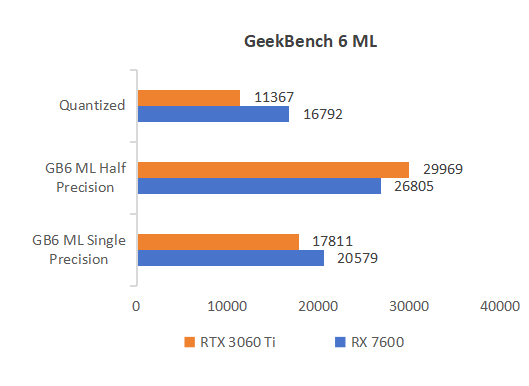
Geekbench ML results show that the RX 7600 performs better in single-precision and quantized tests, while the RTX 3060 Ti leads in half-precision workloads, which are more relevant to real-world AI inference. Thanks to CUDA and Tensor Cores, the RTX 3060 Ti delivers more practical and consistent performance for modern machine-learning tasks, despite the RX 7600’s higher raw compute scores in some benchmarks.
Gaming Performance
The GeForce RTX 3060 Ti and Radeon RX 7600 are both mainstream GPUs, optimized for 1080p and 1440p gaming while also capable of entry-level GPU workloads. Their performance differs across resolutions, with the RTX 3060 Ti generally providing higher frame rates and smoother gameplay compared to the RX 7600. Below is a bar chart comparing their performance across 1080p, 1440p, and 4K settings:
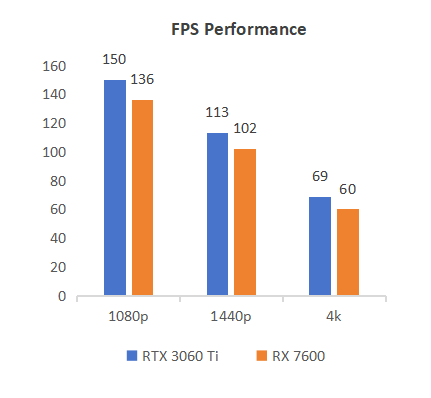
At 1080p, the RTX 3060 Ti runs about 10% faster than the RX 7600, offering smoother gameplay.
At 1440p, it maintains a 12% lead, allowing higher settings while the RX 7600 may need medium settings.
At 4K, the RTX 3060 Ti is roughly 15% faster, though both struggle with frame rates.
The RTX 3060 Ti’s higher memory bandwidth and more cores give it better performance, while the RX 7600 is more limited in demanding resolutions.
3D Rendering
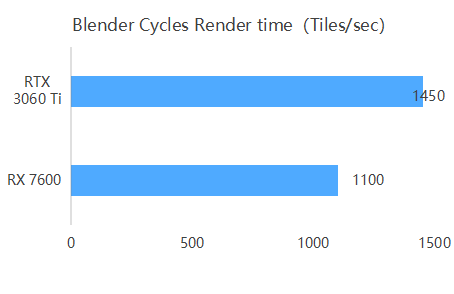
Based on the Blender Cycles rendering data, the RTX 3060 Ti renders approximately 32% faster than the Radeon RX 7600, achieving around 1450 tiles/sec compared to 1100 tiles/sec. This advantage comes from the RTX 3060 Ti’s higher number of CUDA cores, greater memory bandwidth, and support for OptiX ray-tracing acceleration, which together improve rendering speed and efficiency. The RX 7600 remains suitable for basic or moderately complex scenes but is noticeably slower in demanding 3D rendering tasks.
Price & Value: RX 7600 vs RTX 3060 Ti
The RX 7600 and RTX 3060 Ti occupy the mid-to-upper mainstream GPU market, with the 3060 Ti priced roughly $130 higher (~33%). The 3060 Ti provides ray tracing, DLSS, and Tensor Core AI acceleration, while the RX 7600 delivers efficient 1080p gaming at a more affordable price. The RX 7600 is ideal for budget-conscious users, whereas the 3060 Ti is better suited for those seeking higher performance, future-proofing, and advanced gaming features.
Price Comparison
| Platform / Retailer | AMD RX 7600 (USD) | NVIDIA RTX 3060 Ti (USD) | Price Difference (USD) | Price Difference (%) |
|---|---|---|---|---|
| Official MSRP | ~$269 | ~$399 | –$130 | –33% |
| Retail / Resellers | ~$270–$350 | ~$400–$500 | –$130–$150 | –32%–33% |
| Secondary / Marketplace | ~$250–$340 | ~$380–$480 | –$130–$140 | –32%–34% |
User Value-for-Money Feedback
User value‑for‑money feedback generally shows that the RX 7600 delivers strong performance per dollar for 1080p gaming and standard GPU tasks compared with the RTX 3060 Ti, since it costs significantly less while handling most 1080p/1440p workloads effectively. The RTX 3060 Ti, though more expensive, adds ray tracing, DLSS, and higher overall performance, making it worthwhile only if these features or higher settings are important to the user.
RX 7600 vs RTX 3060 Ti – Pros & Cons
| Model | Pros | Cons |
|---|---|---|
| RX 7600 | ✅ Strong performance for 1080p gaming and standard GPU tasks ✅ Lower cost with good value per dollar ✅ Efficient power consumption and cooling ✅ Modern display support and FSR upscaling |
❌ Lacks dedicated AI/Tensor cores ❌ Limited ray tracing performance ❌ Less future-proof for 1440p high-settings or demanding creative workloads |
| RTX 3060 Ti | ✅ Higher raw performance than RX 7600 ✅ Supports ray tracing and DLSS for enhanced graphics ✅ Better future-proofing for 1440p gaming and AI-accelerated tasks ✅ Strong software ecosystem for creative/professional use |
❌ Higher cost compared to RX 7600 ❌ Higher power draw ❌ May be overkill for pure 1080p gaming where RX 7600 is sufficient |
RX 7600 vs RTX 3060 Ti Hosting
The RX 7600 and RTX 3060 Ti cater to mid-to-upper mainstream performance needs, making them suitable for 1080p–1440p gaming, 3D rendering, video editing, and GPU-accelerated workloads. The RX 7600 delivers efficient performance for 1080p gaming and standard GPU tasks, while the RTX 3060 Ti offers higher raw performance, along with ray tracing and DLSS support for enhanced visuals and future-proofing.
For individuals or teams needing GPU resources without investing in local hardware, GPU hosting provides a flexible and cost-effective solution. Database Mart offers RTX 3060 Ti GPU servers, providing affordable access to powerful GPUs. The RTX 3060 Ti delivers high raw performance, along with ray tracing and DLSS support, making it ideal for demanding projects, enhanced visuals, and future-proofing GPU-intensive workflows.
Conclusion
RX 7600: Mid-range GPU, optimized for 1080p gaming, 3D rendering, video editing, and standard GPU tasks. Energy-efficient and cost-effective. Limited VRAM may restrict large AI models.
RTX 3060 Ti: Upper mid-range GPU with higher raw performance, supports ray tracing and DLSS, suitable for demanding gaming, creative workloads, and AI-accelerated tasks. VRAM may still limit very large AI models.
Summary: Both RX 7600 and RTX 3060 Ti deliver strong performance for gaming and GPU workloads, but only the 3060 Ti adds advanced features like ray tracing and AI acceleration. VRAM limitations mean very large AI models may require higher-end GPUs.
rx 7600 vs rtx 3060 ti, rx 7600 vs rtx 3060 ti benchmark, rx 7600 vs rtx 3060 ti price, rtx 3060 ti vs rx 7600 GPU, nvidia rtx, 3060 ti vs rx 7600, rtx 3060 ti vs rx 7600 performance, amd rx 7600 vs rtx 3060 ti