


GTX 1660 vs RTX 2060 : Which GPU Offers the Best Performance and Value?
Explore the performance and value differences between the GTX 1660 and RTX 2060. Compare gaming capabilities, AI/ML performance, power efficiency, and price to determine which GPU best fits your needs and budget.
GTX 1660 vs RTX 2060 – Background Comparison
| Brand | Series | Model | Release Year | Official Positioning | Market Price (USD) |
|---|---|---|---|---|---|
| NVIDIA | GeForce | GTX 1660 | 2019 | The NVIDIA GTX 1660 is a mid-range GPU designed for 1080p gaming, offering solid performance, efficiency, and affordability without RTX features. | $219 |
| NVIDIA | GeForce | GTX 2060 | 2019 | The NVIDIA RTX 2060 is powered by the NVIDIA Turing architecture, bringing incredible performance and the power of real-time ray tracing and AI to the latest games and to every gamer. | $349 |
NVIDIA GTX 1660 vs RTX 2060– Specifications Comparison
The NVIDIA RTX 2060 and GTX 1660 are both Turing-based GPUs, but they target different performance and feature segments. While the GTX 1660 delivers solid 1080p gaming performance without advanced ray tracing or AI capabilities, the RTX 2060 introduces real-time ray tracing, AI-powered Tensor cores, and higher computational performance, making it a more future-proof option for gamers and creators who need enhanced graphics features and compute power.
Core Specs Comparison between GTX 1660 vs RTX 2060
| Specification | RTX 2060 | GTX 1660 | RTX 2060 Improvement / Gain |
|---|---|---|---|
| Architecture | Turing (RTX) | Turing (No RT/Tensor) | Adds RT & Tensor cores |
| CUDA Cores | 1920 | 1,408 | +36% more cores |
| Memory Type | GDDR6 | GDDR5 | Faster memory type |
| Memory Capacity | 6 GB | 6 GB | Same capacity |
| Memory Bandwidth | 336 GB/s | 192 GB/s | +75% bandwidth |
| Core Frequency (Base / Boost) | ~1365 / 1680 MHz | ~1.78 GHz (varies) | Slightly lower clocks, more cores |
| TDP (Power Draw) | 160 W | 120 W | +33% power consumption |
| Interface | PCIe 3.0 x16 | PCIe 3.0 x16 | Same |
| FP32 Performance | ~6.5 TFLOPS | ~5.0 TFLOPS | +30% compute performance |
| Tensor Cores | Yes (240) | No | RTX-only AI feature |
| PCIe Interface | PCIe 3.0 x16 | PCIe 3.0 x16 | Same |
Key Differences
Ray Tracing & AI Features – RTX 2060 supports real-time ray tracing and AI-powered Tensor cores, enabling more realistic graphics and enhanced effects, while GTX 1660 does not.
Performance– With more CUDA cores and higher FP32 performance (~6.5 TFLOPS vs ~5.0 TFLOPS), the RTX 2060 delivers smoother gameplay and faster rendering.
Memory Bandwidth – Faster GDDR6 memory on the RTX 2060 (336 GB/s vs 192 GB/s) improves texture loading, frame rates, and overall responsiveness in demanding applications.
GTX 1660 vs RTX 2060 Performance Across Different Scenarios
Artificial Intelligence Testing
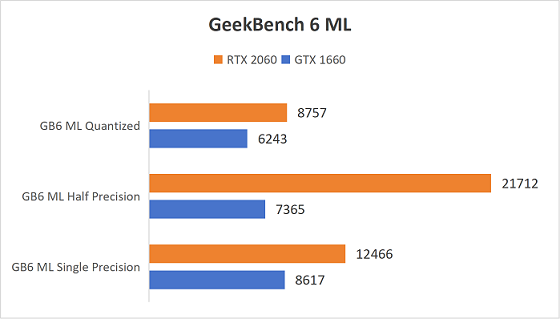
Artificial intelligence workloads place heavy demands on GPU compute capability, memory efficiency, and support for mixed-precision operations. To evaluate real-world AI performance differences between the GTX 1660 and RTX 2060, we compared their results using Geekbench 6 Machine Learning benchmarks across single precision, half precision, and quantized workloads. These tests reflect common AI scenarios such as model inference, training acceleration, and performance optimization techniques widely used in modern machine learning applications.
Single Precision Performance
The RTX 2060 outperforms the GTX 1660 by approximately 45%, enabling faster computation for standard AI and machine learning workloads.Half Precision Performance
The performance gap is most significant in half-precision tasks, where the RTX 2060 delivers nearly 3× higher performance, greatly accelerating mixed-precision training and inference.Quantized Workloads
In quantized machine learning scenarios, the RTX 2060 maintains around 40% performance improvement, providing faster and more efficient inference for optimized AI models.Overall AI Experience
While the GTX 1660 can handle basic AI tasks, the RTX 2060 offers a clearly superior experience, especially for modern AI workflows that rely on mixed-precision and optimized inference.
Gaming Performance
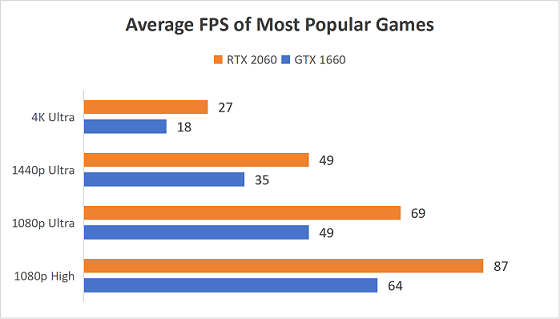
Gaming performance is highly dependent on GPU compute power, memory bandwidth, and the ability to sustain higher frame rates at increased resolutions and quality settings. To evaluate real-world gaming differences between the GTX 1660 and RTX 2060, we compared average frame rates across multiple resolutions and graphics presets, including 1080p High, 1080p Ultra, 1440p Ultra, and 4K Ultra. These scenarios represent common gaming use cases, from competitive 1080p gaming to high-resolution, graphics-intensive gameplay.
Summary
1080p Gaming
At 1080p High and Ultra settings, the RTX 2060 delivers approximately 35–40% higher frame rates, resulting in smoother gameplay and better stability during fast-paced scenes.1440p Performance
At 1440p Ultra, the RTX 2060 maintains a clear advantage with roughly 40% higher performance, making higher-resolution gaming more playable and consistent.4K Gaming
In 4K Ultra scenarios, both GPUs are heavily taxed, but the RTX 2060 still provides about 50% higher frame rates, offering a more usable experience compared to the GTX 1660.Overall Gaming Experience
While the GTX 1660 remains suitable for 1080p gaming, the RTX 2060 delivers a noticeably smoother and more scalable experience across higher resolutions and ultra settings.
Combined Synthetic Benchmark Score
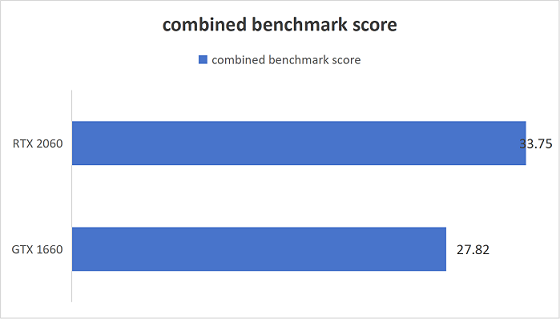
The combined benchmark score provides an overall evaluation of GPU performance by aggregating results from multiple workloads, including compute, graphics, and real-world application scenarios. This metric offers a high-level view of how the GTX 1660 and RTX 2060 perform across a balanced range of tasks, making it useful for users who want a general comparison rather than focusing on a single use case.
Summary
Overall Performance Advantage
The RTX 2060 achieves a combined benchmark score of 33.75, compared to 27.82 on the GTX 1660, reflecting an overall performance improvement of approximately 21%.Balanced Workload Performance
This performance gain indicates that the RTX 2060 delivers consistently better results across mixed workloads, including gaming, content creation, and compute-heavy tasks.User Experience Impact
In everyday use, the higher combined score of the RTX 2060 translates into smoother performance, faster task completion, and better scalability for more demanding applications.
Price & Value: GTX 1660 vs RTX 2060
The pricing of GTX 1660 and RTX 2060 varies significantly across platforms and retail channels, including official MSRP, major online retailers, and secondary marketplaces. This variation directly affects the perceived value-for-money for consumers, influencing purchasing decisions based on both performance expectations and budget considerations.
Price Comparison
| Platform / Retailer | GTX 1660 (USD) | RTX 2060 (USD) | Price Difference (USD) | Price Difference (%) |
|---|---|---|---|---|
| Official MSRP | ~$219 | ~$349 | +$130 | +59% |
| Retail (Amazon / Newegg) | ~$220–$249 | ~$230–$319 | –$19–$99 | –9%–45% |
| Secondary / Marketplace | ~$200–$280 | ~$140–$189 | –$60––$91 | –30%–46% |
User Value-for-Money Feedback
GTX 1660
The GTX 1660 offers relatively stable pricing across official MSRP, major retail, and secondary markets. Users can expect predictable costs for reliable mid-range performance, making it suitable for those seeking a balanced budget and consistent everyday experience.RTX 2060
The RTX 2060 shows significant price variation across channels:
At official MSRP and major retail, it is generally more expensive than the GTX 1660, offering higher performance at a higher cost.
On the secondary market, it can sometimes be cheaper than the GTX 1660, providing high value-for-money opportunities, but the fluctuating prices require careful monitoring.
- Overall Recommendation
Users with limited budgets who prefer stable pricing should opt for the GTX 1660. Those seeking higher performance and willing to monitor market prices can benefit from the RTX 2060’s potential for better value.
GTX 1660 vs RTX 2060 – Pros & Cons
| Model | Pros | Cons |
|---|---|---|
| GTX 1660 | ✅ Affordable and stable pricing ✅ Good 1080p gaming performance ✅ Low power consumption and efficient cooling ✅ Solid choice for casual gamers and creators |
❌ Lacks ray tracing and Tensor cores ❌ Less future-proof for upcoming games ❌ Weaker AI/ML performance compared to RTX 2060 |
| RTX 2060 | ✅ Higher overall performance ✅ Supports ray tracing and Tensor cores ✅ Strong 1440p gaming and creative tasks ✅ Better for AI/ML workloads |
❌ Higher cost compared to GTX 1660 ❌ Higher power draw and heat ❌ Price can fluctuate widely on retail and secondary markets |
GTX 1660 vs RTX 2060 Hosting
GPU hosting has become a practical solution for users who need dedicated GPU resources without investing in physical hardware. Instead of focusing solely on raw GPU specifications, the key question in a hosting environment is how well a GPU fits different hosted workloads and usage scenarios.
Both GTX 1660 and RTX 2060 are commonly deployed in GPU hosting platforms, offering users flexible options based on workload intensity and budget.
GPU Hosting as a Practical Solution
In a hosted environment, GPU performance is closely tied to scalability, cost control, and workload efficiency. GPU hosting allows users to:
Access dedicated GPU resources on demand
Scale workloads without hardware replacement
Reduce upfront infrastructure and maintenance costs
This makes GPU hosting suitable for development teams, content creators, and businesses running GPU-accelerated applications.
GTX 1660 Hosting in Practice
Within GPU hosting platforms, GTX 1660 is typically positioned as an entry-level option. It provides stable GPU acceleration for tasks such as:
Application development and testing
Video processing and encoding
Lightweight compute workloads
General GPU-assisted tasks
While GTX 1660 does not support ray tracing, it remains a cost-efficient hosting option for users whose workloads do not require advanced rendering features.
RTX 2060 Hosting in Practice
RTX 2060 hosting targets users with higher performance requirements. In hosted environments, it offers:
Faster processing for GPU-intensive applications
Support for modern rendering engines and workflows
Better performance headroom for sustained workloads
With RTX feature support, RTX 2060 hosting is more suitable for production environments, complex visual workloads, and projects that may scale over time.
GPU Hosting Options from Database Mart
Database Mart provides GPU hosting solutions featuring both GTX 1660 and RTX 2060, enabling users to select the GPU tier that best aligns with their workload demands. This flexibility allows users to start with a GTX 1660 for basic GPU needs and transition to RTX 2060 hosting as project complexity increases.
With GPU hosting options from Database Mart, users can deploy the appropriate GPU resources while maintaining flexibility, control, and cost efficiency.
Conclusion
Choosing between the GTX 1660 and RTX 2060 ultimately depends on your performance needs, budget, and intended use.
The GTX 1660 offers a stable, affordable option with solid 1080p gaming performance, low power consumption, and predictable pricing. It is ideal for casual gamers, budget-conscious users, or those who don’t require advanced features like ray tracing or AI acceleration.
The RTX 2060, on the other hand, delivers higher overall performance, better 1440p gaming experiences, and support for modern technologies such as ray tracing, DLSS, and AI/machine learning workloads. While its price can be higher and more variable across retail and secondary markets, it provides better future-proofing and versatility for gamers and creators who want to take advantage of next-generation features.
In summary, if you prioritize value and efficiency, the GTX 1660 remains a dependable choice. If you seek enhanced performance and cutting-edge features, and are willing to invest a bit more, the RTX 2060 is the superior option. Ultimately, understanding your specific needs and budget will help you make the best GPU choice.
gtx 1660 vs rtx 2060, 2060 vs 1660, gtx 1660 price, rtx 2060 price, gtx 1660 specs, rtx 2060 specs, rtx 2060 benchmark, gtx 1660 benchmark, nvidia gtx 1660, nvidia rtx 2060