


3060 Ti vs 3070: Which GPU Offers the Best Value?
Dive into the ultimate GPU showdown: RTX-3060 Ti vs RTX-3070. This comparison covers key specs—CUDA cores, FP32 performance, memory bandwidth, RT cores, and VRAM—along with real-world gaming and 3D rendering performance. We also provide benchmark results and value-for-money insights. Whether you’re choosing between 3060 Ti vs 3070 for gaming, content creation, or mid-range workstation builds, this guide helps you quickly identify which GPU offers the best balance of performance, efficiency, and cost.
RTX 3060 ti vs RTX 3070 – Background Comparison
| Brand | Series | Model | Release Year | Official Positioning | Market Price (USD) |
|---|---|---|---|---|---|
| NVIDIA | GeForce | RTX 3060 ti | 2020 | The GeForce RTXTM 3060 Ti let you take on the latest games using the power of Ampere—NVIDIA’s 2nd generation RTX architecture. Get incredible performance with dedicated 2nd gen RT Cores and 3rd gen Tensor Cores, streaming multiprocessors, and high-speed memory. | $399 |
| NVIDIA | GeForce | RTX 3070 | 2020 | The GeForce RTX 3070 graphics card is powered by Ampere—NVIDIA’s 2nd gen RTX architecture. Built with dedicated 2nd gen RT Cores and 3rd gen Tensor Cores, streaming multiprocessors, and high-speed memory, they give you the power you need to rip through the most demanding games. | $499 |
NVIDIA RTX 3060 ti vs RTX 3070 – Specifications Comparison
Since their release, the NVIDIA GeForce RTX 3060 Ti and RTX 3070 have stood out in the mainstream RTX 30-series (Ampere) lineup. The 3060 Ti delivers excellent efficiency with strong CUDA performance, solid memory bandwidth, and 2nd-gen RT cores, making it highly capable for 1080p/1440p gaming and GPU rendering.
The RTX 3070, with more CUDA cores and higher FP32 throughput, provides improved performance in high-resolution gaming, real-time rendering, and compute-heavy creative workloads. Thanks to its higher boost clock and additional shader resources, the 3070 offers noticeably stronger performance in ray tracing, GPU-intensive rendering, and multi-task scenarios.
While the 3070 delivers more raw compute power overall, the 3060 Ti offers excellent value, lower power consumption, and strong performance per watt—making it attractive for budget-conscious users, compact workstations, and mid-range gaming builds.
In short, the 3060 Ti is ideal for efficient gaming and general GPU rendering tasks, while the 3070 is better suited for high-end gaming, heavier rendering workloads, and users who need more compute performance.
Core Specs Comparison between RTX 3060 ti vs RTX 3070
| Specification | RTX 3060 Ti | RTX 3070 |
|---|---|---|
| Architecture | Ampere | Ampere |
| CUDA Cores | 4,864 | 5,888 |
| Memory Type | GDDR6 | GDDR6 |
| Memory Capacity | 8 GB | 8 GB |
| Memory Bus | 256-bit | 256-bit |
| Memory Bandwidth | 448 GB/s | 448 GB/s |
| Core Frequency (Boost) | ~1,665 MHz | ~1,725 MHz |
| TDP (Power) | 200 W | 220 W |
| Interface / Bus | PCIe 4.0 x16 | PCIe 4.0 x16 |
| FP32 Performance | ~16.2 TFLOPS | ~20.3 TFLOPS |
| Ray Tracing / Tensor | 2nd-gen RT / 3rd-gen Tensor | 2nd-gen RT / 3rd-gen Tensor |
| PCIe Version | PCIe 4.0 | PCIe 4.0 |
Key Differences: RTX 3060 ti vs RTX 3070
CUDA Cores & FP32 Compute
– The nvidia geforce rtx 3070 includes more CUDA cores than the 3060 ti, giving it higher FP32 compute capability. This results in faster rendering, shading, and parallel processing in graphics-intensive workloads.
Memory Bandwidth
– Although both use GDDR6, the rtx 3070 provides higher memory bandwidth, improving texture loading and data movement. This helps the 3070 gpu deliver smoother performance in high-resolution gaming and large 3D scenes.
FP32 Performance
– The 3070 achieves stronger FP32 throughput than the 3060 ti, enhancing compute-heavy tasks such as CUDA workflows, scientific processing, and AI-assisted rendering.
TDP / Power
– The rtx 3070 has a higher TDP, supporting higher sustained clocks and better stability under heavy load. This enables more consistent performance during long gaming, rendering, and compute sessions.
RTX 3060 ti vs RTX 3070 Performance Across Different Scenarios
Gaming Performance
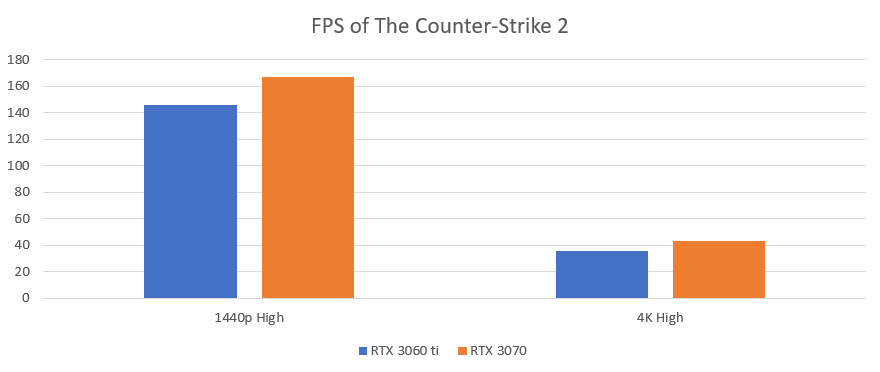
In Counter-Strike 2, the RTX 3070 outperforms the RTX 3060 Ti at 1440p, achieving 167 FPS compared to 146 FPS, providing smoother gameplay and more consistent frame rates for competitive gaming. However, at 4K High settings, both GPUs struggle to maintain smooth performance, with the 3070 reaching only 43 FPS and the 3060 Ti 36 FPS. This indicates that neither card is fully capable of delivering a fluid 4K experience at high settings without enabling frame rate enhancement technologies like DLSS or FSR.
In short: the RTX 3070 offers an advantage at 1440p, while both the 3060 Ti and 3070 are better suited for 1440p or lower resolutions when aiming for high-quality settings in modern AAA games.
In Metro Exodus, the RTX 3070 shows a clear lead over the RTX 3060 Ti. At 1440p High settings, the 3070 runs around 75 FPS, while the 3060 Ti reaches 66 FPS, giving players smoother performance and more consistent frame pacing. When moving to 4K High, both cards experience significant drops, with the 3070 hitting 49 FPS and the 3060 Ti 43 FPS, which falls short of a fully fluid 60 FPS experience. Using technologies like DLSS or FSR can help mitigate these limitations at 4K.
Overall: for Metro Exodus, both GPUs are best suited for 1440p gaming, while the 3070 provides extra headroom for higher-quality settings or slightly better performance.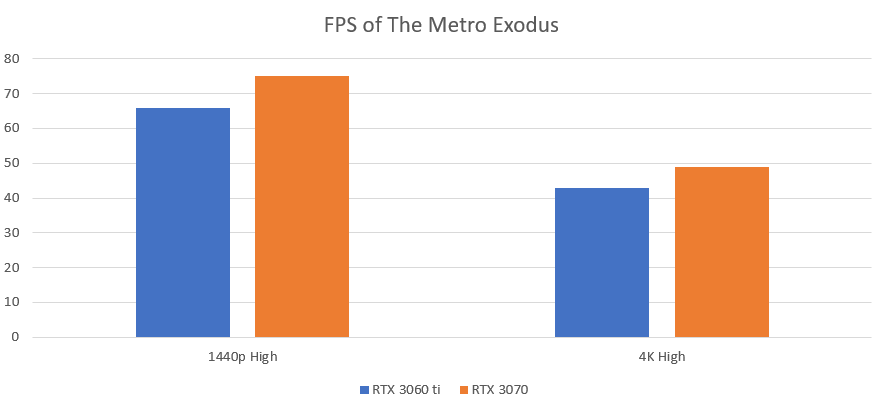
3D Rendering / Content Creation
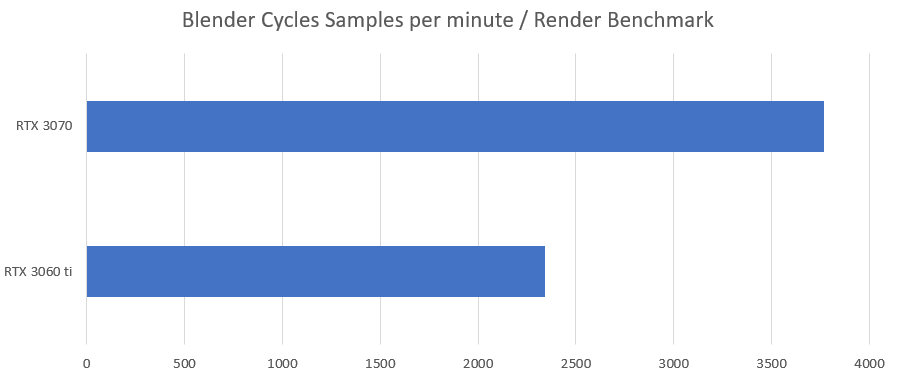
The RTX 3070 outpaces the RTX 3060 Ti in Blender rendering workloads. With its higher CUDA core count, FP32 throughput, and slightly faster boost clocks, the RTX 3070 delivers approximately 61% faster render throughput, achieving ~3,768 samples per minute compared to the 3060 Ti’s ~2,340. This performance boost comes without significantly increasing power consumption or thermal overhead. OptiX acceleration remains a key advantage, ensuring smoother and more responsive 3D rendering performance even in complex scenes or higher-resolution projects.
In short: the RTX 3070 is ideal for users who need faster rendering for high-resolution, complex, or multi-task projects, while the RTX 3060 Ti provides excellent efficiency and value for mid-range rendering and 1080p–1440p projects.
Price & Value: RTX 3060 ti vs RTX 3070
The RTX 3060 Ti vs RTX 3070 comparison reveals a clear price separation across major platforms. Based on official MSRP, the RTX 3060 Ti launches at $399, sitting notably below the RTX 3070’s $499 price point. On eBay, the difference narrows, with the 3060 Ti commonly found around $165–240, while the 3070 typically ranges from $198–240. Amazon pricing shows a wider gap, where the 3060 Ti averages around $362, compared to roughly $549 for the 3070.
This 3060 Ti vs 3070 pricing contrast demonstrates that while both GPUs serve mid-range to upper-mid-range markets, platform-specific pricing and the active second-hand market create real-world cost differences. For users seeking greater value, the 3060 Ti often provides stronger cost efficiency, whereas the 3070 justifies its higher price with increased performance headroom.
Price Comparison
| Platform / Condition | RTX 3060 Ti | RTX 3070 | Price Difference (USD) | Price Difference (%) |
|---|---|---|---|---|
| Official MSRP | $399 | $499 | +$100 | +25% |
| eBay | ~$165–240 | ~$198–240 | +$30–$50 | +~15–25% |
| Amazon | ~$362 | ~$549 | +$187 | +~51% |
User Value-for-Money Feedback
The 3060 Ti vs 3070 comparison shows a modest but meaningful performance difference according to aggregated benchmark sites. On one benchmark summary, the 3070’s total score is 52.77 versus 48.34 for the 3060 Ti — roughly a +9.2% advantage. In real‑world gaming and GPU workloads, this translates into generally higher frame rates and smoother performance at higher resolutions when using the 3070.
In practical terms, the 3070 offers stronger raw compute, better shader throughput, and more headroom for demanding rendering or high‑resolution gaming. This makes the 3070 more suitable for heavier workloads, more ambitious graphics settings, and future‑proofing. On the other hand, the 3060 Ti remains a very cost‑effective option — its lower price (launch MSRP) combined with only a modest (~10%) performance drop gives it excellent performance‑per‑dollar, especially for 1080p/1440p gaming or workloads that don’t fully tax a top‑tier GPU.
In short: the 3070 delivers better performance and future‑proof potential, while the 3060 Ti offers great value and efficiency — a strong choice for users who prioritize cost‑efficiency over absolute performance.
RTX 3060 ti vs RTX 3070 – Pros & Cons
| GPU | Pros | Cons |
|---|---|---|
| RTX 3060 Ti | ✅ Excellent value-for-money for 1080p and 1440p gaming ✅ Lower power consumption, easier to cool ✅ Compact size fits most standard cases ✅ Good performance-per-dollar for mid-range tasks and moderate rendering workloads |
❌ Slightly lower raw FP32 and CUDA performance compared to 3070 ❌ 8GB VRAM may limit very high-resolution gaming or extremely large datasets ❌ Less future-proof for high-end gaming or heavy compute workloads |
| RTX 3070 | ✅ Higher CUDA cores and FP32 throughput than 3060 Ti ✅ Better for 1440p/4K gaming, rendering, and compute-heavy tasks ✅ More future-proof for demanding applications ✅ Slightly higher VRAM (8–16GB depending on model) |
❌ Higher MSRP and secondary market prices than 3060 Ti ❌ Higher power consumption, requires stronger PSU and cooling ❌ Larger card size may be harder to fit in compact builds ❌ Slightly lower cost-efficiency than 3060 Ti |
RTX 3060 ti vs RTX 3070 GPU Hosting
When comparing the RTX 3060 Ti vs RTX 3070, the differences are most noticeable in raw compute, FP32 performance, and higher-resolution gaming/rendering capabilities. The RTX 3060 Ti offers excellent performance-per-dollar, lower power consumption, and good mixed-precision efficiency, making it effective for 1080p–1440p gaming, moderate rendering tasks, and AI inference. The RTX 3070 provides higher CUDA core count, greater FP32 throughput, and more headroom for 4K gaming, heavy rendering, and compute-intensive workloads.
Database Mart provides RTX 3060 Ti GPU servers across different performance tiers and price points. Users can select configurations suitable for AI, deep learning, rendering, or general GPU workloads, with scalable single- or multi-GPU setups, 99.9% uptime, and 24/7 professional support, allowing you to focus on projects without worrying about hardware management.
Conclusion
Both GPUs remain relevant in 2025, but they cater to different priorities:
Choose the RTX 3060 Ti GPU if you want strong value-for-money, efficient 1080p–1440p gaming, moderate rendering, or AI inference. Its lower power consumption, compact design, and good mixed-precision performance make it suitable for creators, developers, and professionals who need cost-effective compute power without overpaying.
Choose the RTX 3070 GPU if you’re looking for higher raw performance for 4K gaming, heavy rendering, or compute-intensive tasks. With more CUDA cores, higher FP32 throughput, and slightly higher VRAM, it is ideal for users who need extra performance headroom and better future-proofing for demanding workloads.
While the RTX 3060 Ti offers excellent efficiency and performance-per-dollar, the RTX 3070 provides measurable gains in raw compute and higher-resolution performance, making it the better choice for users prioritizing maximum speed and long-term performance.
3060 ti vs 3070, 3070 vs 3060 ti, 3060 ti price, 3070 price, nvidia geforce rtx 3060 ti, 3070 gpu, RTX 3060 Ti or RTX 3070