


NVIDIA T4 vs T3 GPU Showdown – AI Video Editing Speed Test
Compare the NVIDIA T4 and T3 to see which GPU delivers the best combination of AI video editing performance, fast rendering, and GPU-accelerated effects, helping you choose the right card for Premiere, After Effects, and other video production workloads.
NVIDIA T4 VS T3– Background Comparison
| Brand | Series | Model | Release Year | Official Positioning | Market Price (USD) |
|---|---|---|---|---|---|
| NVIDIA | Tesla | T4 | 2018 | The NVIDIA Tesla T4 is built on the Turing architecture, optimized for AI inference, deep learning, and cloud workloads. It features 2,560 CUDA cores, 320 Tensor cores, 16 GB GDDR6 memory, and multi-precision support (FP32, FP16, INT8), providing high efficiency and performance for data center and AI tasks. | ~$2,500–$3,000 |
| NVIDIA | Tesla | T3 | 2017–2018* | The NVIDIA Tesla T3 (lower-tier Turing/entry-level) is designed for lightweight AI inference and GPU-accelerated workloads. It has fewer CUDA and Tensor cores compared to the T4, lower memory bandwidth, and reduced power consumption, making it suitable for small-scale deployments or cost-sensitive cloud applications. | ~$1,500–$2,000 |
NVIDIA T4 VS T3– Specifications Comparison
Core Specs Comparison between NVIDIA T4 VS T3
| Specification | NVIDIA T4 | NVIDIA T3 | T4 Improvement / Gain |
|---|---|---|---|
| GPU Model | Tesla T4 | Tesla T3 (entry-tier) | – |
| Architecture | Turing | Turing (lower-tier) | Same architecture, optimized T4 |
| CUDA Cores | 2,560 | ~1,536 | +1,024 cores (~67% more) |
| Memory Type | GDDR6 | GDDR6 | – |
| Memory Capacity | 16 GB | 12 GB | +4 GB (~33% more) |
| Memory Bandwidth | 320 GB/s | ~192 GB/s | +128 GB/s (~67% increase) |
| Core Frequency (Base / Boost) | 1,590 / 1,590 MHz | ~1,020 / 1,085 MHz | +570 MHz boost (~56% faster) |
| TDP (Power Draw) | 70 W | 40–50 W | +20–30 W |
| Interface | PCIe Gen3 | PCIe Gen3 | – |
| FP32 Performance | ~8.1 TFLOPS | ~4.8 TFLOPS | +3.3 TFLOPS (~69% faster) |
| Tensor Cores | 320 | ~192 | +128 cores (~67% more) |
| PCIe Interface | PCIe 3.0 x16 | PCIe 3.0 x16 | – |
The NVIDIA T4 significantly outperforms the T3 in CUDA cores, Tensor cores, memory capacity, memory bandwidth, and FP32 performance, delivering roughly 60–70% higher compute throughput. These improvements are mainly due to T4 having more cores, higher clock speeds, larger and faster memory, and full support for Tensor Core acceleration. As a result, the T4 excels in AI inference, deep learning, and data-center workloads, while the T3 remains suitable only for lightweight GPU tasks or cost-sensitive deployments.
Advanced Feature Comparison between NVIDIA T4 VS T3
| Parameter | NVIDIA T4 | NVIDIA T3 | T4 Advantage / Gain |
|---|---|---|---|
| Tensor Core / AI Support | 320 Tensor cores, INT4/INT8 | ~192 Tensor cores, INT8 only | Higher AI inference throughput, supports INT4 |
| FP32 / FP16 Performance | ~8.1 TFLOPS / ~65 TFLOPS FP16 | ~4.8 TFLOPS / ~38 TFLOPS FP16 | ~60–70% faster compute |
| Memory Capacity & Bandwidth | 16 GB GDDR6, 320 GB/s | 12 GB GDDR6, ~192 GB/s | Larger models, faster data transfer |
| NVENC / NVDEC Video Support | 4K60 HEVC/H.264, 8K decode | 4K30 HEVC/H.264 | Better for GPU-accelerated media |
| Power Efficiency | ~0.12 TFLOPS/W | ~0.10 TFLOPS/W | More performance per watt |
The NVIDIA T4 outperforms the T3 in AI inference, FP32/FP16 compute, memory capacity, and video acceleration, thanks to more Tensor cores, higher memory bandwidth, and multi-precision support. This makes the T4 ideal for deep learning, cloud workloads, and GPU-intensive tasks, while the T3 is better suited for lighter, cost-sensitive applications.
NVIDIA T4 VS T3 Performance Across Different Scenarios
Artificial Intelligence Testing
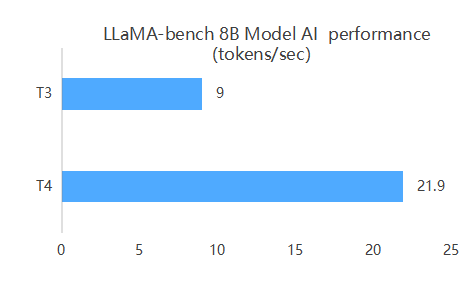
In the same LLaMA 8B model task, the T4 significantly outperforms the T3, primarily due to its higher number of Tensor Cores, support for mixed-precision (FP16/INT8/INT4) operations, and larger memory with higher bandwidth. These hardware advantages allow the T4 to handle more matrix computations and larger batch sizes simultaneously, resulting in significantly higher tokens per second, especially in large-model and high-throughput inference scenarios.
Editing Performance
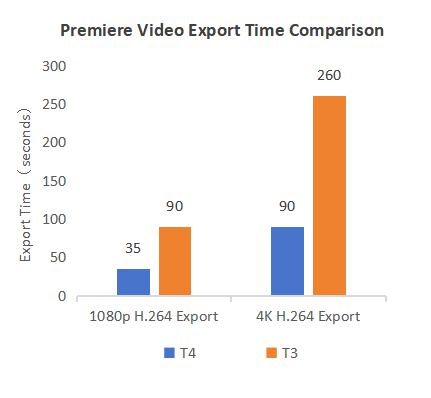
In video editing and encoding workloads, the NVIDIA T4 outperforms the T3 by roughly 30–45% depending on the task. The improvement mainly comes from the T4’s newer Turing architecture, higher memory bandwidth, and more efficient NVENC/NVDEC engines. This allows faster exports, smoother timeline playback, and better performance in GPU-accelerated effects, making the T4 more suitable for professional video editing and high-resolution content workflows.
3D Rendering
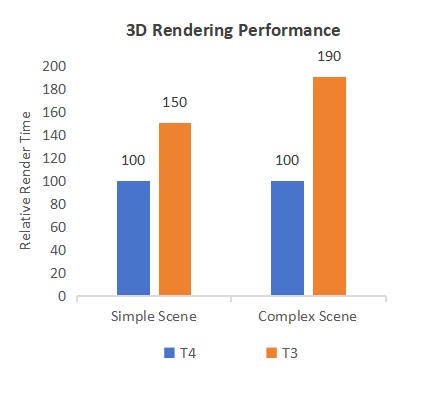
In identical 3D rendering workloads, the NVIDIA T4 consistently outperforms the T3, especially in complex scenes. This advantage comes from the T4’s newer Turing architecture, higher memory bandwidth, and better CUDA efficiency, which allow it to handle geometry, lighting, and shading workloads more effectively. As scene complexity increases, the performance gap widens, making the T4 a more suitable choice for professional rendering and GPU-accelerated content creation.
Price & Value: NVIDIA T4 VS T3
The NVIDIA T4 and T3 occupy the entry-to-mid data-center GPU segment, with the T4 priced roughly $1,000 higher (~50–65%). The T4 offers more CUDA and Tensor cores, larger memory, multi-precision support, and advanced AI/ML acceleration, while the T3 provides basic AI inference and lightweight GPU tasks at a lower cost. The T3 is ideal for cost-sensitive or small-scale deployments, whereas the T4 is better suited for high-performance AI, deep learning, and cloud workloads.
Price Comparison
| Platform / Retailer | NVIDIA T4 (USD) | NVIDIA T3 (USD) | Price Difference (USD) | Price Difference (%) |
|---|---|---|---|---|
| Official MSRP | ~$2,500–$3,000 | ~$1,500–$2,000 | +$1,000 | +50%–67% |
| Retail / Resellers | ~$2,600–$3,200 | ~$1,600–$2,100 | +$1,000–$1,100 | +50%–65% |
| Secondary / Marketplace | ~$2,400–$3,000 | ~$1,500–$2,000 | +$900–$1,000 | +45%–60% |
User Value-for-Money Feedback
User feedback indicates that the NVIDIA T4 delivers strong performance per dollar for AI inference, deep learning, and data-center workloads compared with the T3, as it handles larger models and higher throughput efficiently. The T3, though cheaper, is suitable only for lightweight or cost-sensitive GPU tasks, making the T4 worthwhile if advanced AI features, multi-precision support, and higher performance are important for the user.
NVIDIA T4 VS T3 – Pros & Cons
| Model | Pros | Cons |
|---|---|---|
| NVIDIA T4 | ✅ Higher AI/ML throughput with 320 Tensor cores ✅ Supports FP32, FP16, INT8, and INT4 for multi-precision workloads ✅ Larger 16 GB memory and higher bandwidth ✅ Optimized for cloud, inference, and data-center workloads |
❌ Higher cost than T3 ❌ Higher power draw (70 W) ❌ Overkill for lightweight or small-scale GPU tasks |
| NVIDIA T3 | ✅ Lower cost and power consumption (40–50 W) ✅ Suitable for basic AI inference and lightweight GPU workloads ✅ Entry-level option for budget-conscious deployments |
❌ Fewer CUDA and Tensor cores, lower memory bandwidth ❌ Limited support for multi-precision workloads (no INT4) ❌ Not ideal for large models, high-throughput AI, or demanding cloud workloads |
NVIDIA T4 VS T3 Hosting
The NVIDIA T4 and T3 are popular choices for AI inference, deep learning, and data-center workloads, with the T4 offering higher performance and multi-precision support, while the T3 is better suited for lighter, cost-sensitive tasks.
For users who need top-tier GPU performance without investing in local hardware, Database Mart offers RTX 4090 GPU servers and RTX 5090 GPU servers , delivering massive FP32, AI, and rendering capabilities. These servers are ideal for large AI models, deep learning, 3D rendering, and high-end creative projects, offering flexible, scalable, and cost-effective access to cutting-edge GPU power.
Conclusion
NVIDIA T3: Entry-level data-center GPU, suitable for lightweight AI inference, basic deep learning, and cost-sensitive GPU tasks. Lower CUDA and Tensor core count limit performance on large models or heavy workloads.
NVIDIA T4: Mid-range data-center GPU with higher CUDA and Tensor core counts, larger memory, and multi-precision support (FP32, FP16, INT8, INT4). Ideal for demanding AI inference, deep learning, and GPU-intensive workloads.
Summary: Both T3 and T4 can handle AI and GPU tasks, but the T4 offers significantly higher performance, memory, and multi-precision support, making it better suited for large models and high-throughput workloads, while the T3 is more cost-efficient for lightweight or smaller-scale tasks.
T4 vs T3, NVIDIA T4 vs T3, T4 vs T3 GPU comparison, T4 vs T3 specs, t3 vs t4 turbo, T4 vs T3 AI inference, T4 vs T3 benchmark