


Nvidia RTX 5090 vs 4090: Full Comparison (Specs, Performance, Price in 2025)
The RTX 5090 is the stronger choice for demanding AI workloads, 3D rendering, and high-resolution gaming, thanks to its 32GB of VRAM and significantly higher memory bandwidth. The RTX 4090 remains a powerful alternative if you can find it at a competitive price. For users comparing GPU hosting, the right choice depends on workload requirements, available budget, and whether renting a GPU server is more practical than purchasing hardware.
RTX 5090 vs. RTX 4090: Overview
| Specification | NVIDIA RTX 5090 | NVIDIA RTX 4090 |
|---|---|---|
| Release year | 2025 | 2022 |
| Architecture | Blackwell | Ada Lovelace |
| CUDA cores | 21,760 | 16,384 |
| VRAM | 32GB GDDR7 | 24GB GDDR6X |
| Memory bandwidth | 1,792 GB/s | 1,008 GB/s |
| Interface | PCIe 5.0 x16 | PCIe 4.0 x16 |
| Total graphics power | 575W | 450W |
| Launch MSRP | $1,999 | $1,599 |
The RTX 5090 offers approximately 33% more CUDA cores, 33% more VRAM, and 78% higher memory bandwidth than the RTX 4090. These improvements can benefit memory-intensive AI and rendering workloads, although actual gains depend on the application and configuration.
The RTX 5090 also introduces newer Blackwell features, including DLSS 4 Multi Frame Generation. The RTX 4090 supports DLSS 3 Frame Generation.
RTX 5090 vs. RTX 4090: Performance Comparison
1. AI Training and Inference
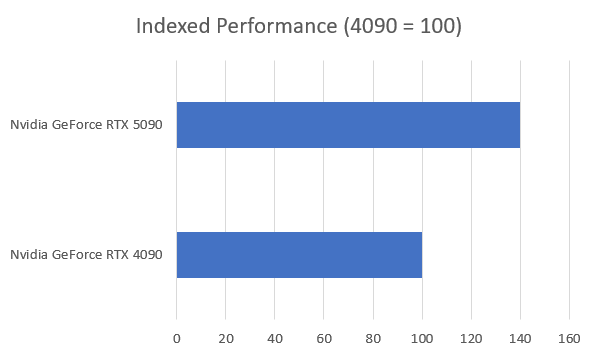
The RTX 5090's 32GB of VRAM and higher memory bandwidth make it attractive for local AI inference, image generation, and model development. Its additional memory can accommodate workloads that exceed the RTX 4090's 24GB capacity.
Actual AI performance gains depend on model architecture, precision, software optimization, and batch size. A reported improvement of around 40% should be treated as workload-specific rather than a universal benchmark.
2. 3D Rendering
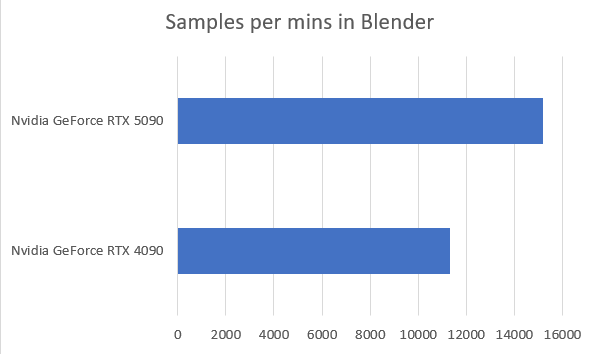
Both GPUs are capable of high-performance rendering in applications such as Blender. The RTX 5090 generally offers an advantage in demanding GPU rendering workloads, particularly when applications benefit from its newer architecture and greater memory bandwidth.
Actual rendering improvements vary by scene complexity, renderer, and software version.
3. Gaming
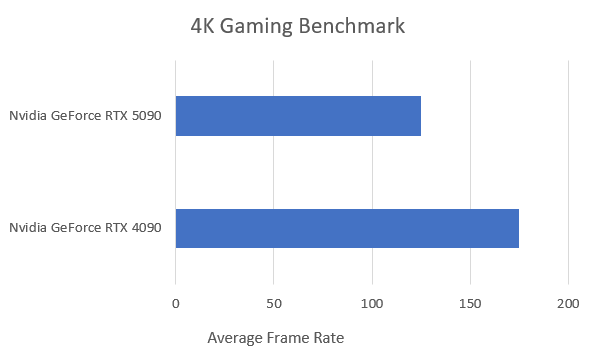
The RTX 5090 is designed for demanding 4K gaming, ray tracing, and supported AI-assisted graphics features. The RTX 4090 remains capable of excellent 4K performance and may offer better value if its price is substantially lower.
At 1440p and 1080p, performance differences can be limited by CPU bottlenecks. Results also vary by game, graphics settings, and whether frame generation is enabled.
4. Video Editing
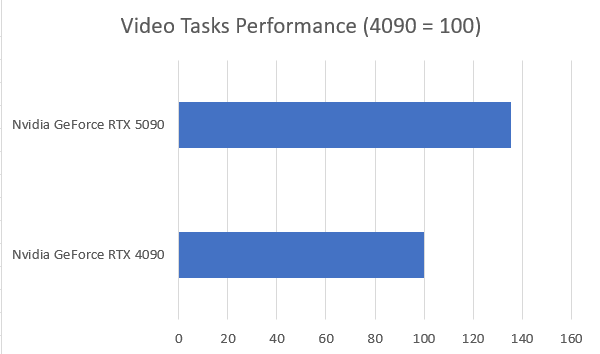
The RTX 5090 features three NVENC encoders and two NVDEC decoders, compared with two encoders and one decoder on the RTX 4090. Its newer media engine also supports additional video-processing capabilities, including supported 4:2:2 decoding workflows.
These improvements can benefit editing, transcoding, and production pipelines, but the overall performance difference depends on the application, codec, and effects used.
RTX 5090 vs. RTX 4090: Price and Value
At launch, the RTX 5090 had an MSRP of $1,999, compared with $1,599 for the RTX 4090—a $400 or 25% difference. Actual retail prices fluctuate with availability, region, board design, and market demand.
| Consideration | RTX 5090 | RTX 4090 |
|---|---|---|
| Initial purchase cost | Higher | Potentially lower, depending on availability |
| AI memory capacity | 32GB | 24GB |
| Power requirement | 575W rated graphics power | 450W rated graphics power |
| Best value scenario | Workloads that benefit from its additional performance or VRAM | Workloads already handled efficiently by 24GB VRAM |
For current pricing, compare listings from Amazon and eBay. Check the exact card model, condition, warranty, and seller reputation before purchasing. Historical price figures should not be treated as current market quotes.
Pros and Cons
| GPU | Advantages | Limitations |
|---|---|---|
| RTX 5090 | 32GB VRAM, higher bandwidth, stronger performance in many demanding workloads, DLSS 4 Multi Frame Generation | Higher cost, 575W power rating, greater cooling and power-supply requirements |
| RTX 4090 | Excellent gaming and rendering performance, 24GB VRAM, lower rated power consumption | Less VRAM and bandwidth, older architecture, no DLSS 4 Multi Frame Generation support |
RTX 5090 and RTX 4090 GPU Hosting
If you need GPU acceleration for AI inference, rendering, video processing, or other compute-intensive workloads, renting a dedicated GPU server can help you avoid upfront hardware costs and maintenance responsibilities.
Database Mart GPU Servers and LLM Hosting are options to explore when comparing dedicated GPU infrastructure. You can also compare RTX 5090 Hosting with RTX 4090 Hosting.
When evaluating a hosting provider or USA hosting provider, compare GPU availability, VRAM, CPU and RAM allocation, storage, network performance, uptime commitments, and total monthly cost. The best server hosting option is the one that meets your workload requirements without paying for unnecessary capacity.
Conclusion
The RTX 5090 is the better fit for users who need more VRAM, higher memory bandwidth, and the latest GPU features. The RTX 4090 remains a compelling option when its price is lower and 24GB of VRAM is sufficient. For AI, rendering, and other workloads that require dedicated GPU resources only for certain periods, GPU hosting may be a practical alternative to buying hardware outright.
5090 vs 4090, rtx 4090 vs 5090, rtx 4090 vs rtx 5090, 5090 vs 4090 for ai, nvidia 5090 vs 4090, 5090 vs 4090 specs, rtx 5090 vs rtx 4090 performance, rtx 5090 vs 4090 price