


Dedicated Server Hosting for Beginners: A Complete Step-by-Step Guide
Dedicated Servers provide you with exclusive hardware resources and a fully controlled environment, eliminating the need to share computing power with others. This ensures enterprise-grade performance, stability, and security to meet the highest demands of your applications.
In this guide, we’ll walk you step by step through the entire process — from ordering and deployment to DBM Panel features, server connection and management, and resource upgrades and expansion — helping you utilize your bare metal server with ease and efficiency while maximizing its hardware performance.
Watch the Video: DBM Dedicated Server Tutorial: Order & Management & Connect
To help you get started quickly, we’ve prepared a short introduction video covering the essential steps and features of DBM Dedicated Server Hosting. In this video, you’ll learn:
- Dedicated Server Ordering Process – How to choose and order a GPU Server.
- Server management Control Panel Features – How to use the DBM control panel for management.
- Windows & Linux Server connection methods (RDP & PuTTY) – How to connect to your Dedicated Server via Remote Desktop (Windows) or SSH (Linux).
Watch the video below to get a clear, step-by-step overview and start using your Dedicated server smoothly.
Purchase Dedicated Server
1. Select the Right Dedicated Hosting Plan:
You can purchase dedicated servers by selecting a suitable plan based on required hardware resources from our Dedicated server offerings. If our standard plans do not meet your requirements, don't hesitate to get in touch with us
to customize your server.
2. Confirm Your Dedicated Hosting Order:
After clicking Order Now, you will be directed to the Order Confirmation Page, where you can configure your server settings, such as server login password, Operating System, Add-ons ( including CPU/RAM/Disk, bandwidth, database, backup), and billing cycle. You can also add any additional requirements in the Note section. Finally, review and submit your order. All of these settings can be modified later through the DBM Panel.
3. Pay for Your Dedicated Server
After confirming your dedicated hosting plan, simply place the order and complete the payment. Before making payments, your account information will be verified. If there are any security issues, the payment may not go through. In such cases, you can contact our Billing Team for assistance.
4. Wait for Dedicated Server Deployment
After payment, your Dedicated server will be deployed automatically. Linux Dedicated servers take about 30 minutes, and Windows Dedicated servers need 40 minutes to 2 hours. If there’s a stock shortage or deployment issue, our Support Team will resolve it within 24 hours. For urgent access, please contact Support directly.
Dedicated Server Management Overview
Once your bare metal server has been successfully deployed, you can easily manage it via the DBM Panel for Dedicated Servers.
In the table below, we’ll guide you through the key features and functions of the dedicated server management interface.
| Tab Name | Sections | Introduction | Functions |
|---|---|---|---|
| Overview | Server Connection Information | This section provides the necessary details for accessing your server, including: IP, Port, Login Name, Login Password, and Operating System. It offers quick tools to reset passwords, add IPs, and access the connection KB. | Primary IP - the unique network address of your server. Access Port – the network port used for remote access. Login Name/Login Password – the server login credentials for authentication. Operating System – the installed OS running on the server. Connections: - Windows Dedicated Server Connection: Use Primary IP:Port (e.g., 108.111.111.11:3389) to connect to Dedicated Server using RDP - Linux Dedicated Server Connection: (Ubuntu/Debian) use sudo -i to switch to the root user |
| Overview | This section displays the essential information of your package, including product, server name, billing cycle, configuration, payment method, price, created date, and due date. It also allows you to directly modify the Server server name, billing cycle, and payment method. | Product - Product Name Name - Server name, can be changed. Billing Cycle: Monthly, quarterly, annually, biennially billing cycle. The longer, the lower the price. Configuration - CPU/RAM/Disk/Bandwidth Payment Method: Support Credit Card and PayPal. It can be changed. Price – Recurring amount. Created – The date that the package is created Due Date – The date that the package expires |
|
| Addon-Option | This section allows clients to purchase add-ons to get more resources. Some of the addon requests will be submitted before payment, so the team can verify if the requests can be met. | Add-ons - Add additional memory, disk space, bandwidth, private network, etc Note: If you need to upgrade to another CPU or a different plan, migration to a higher-capacity host is required, and the IP will change. |
|
| Server Management | Server Control | The Server Control section displays the server status and uptime, and provides control options such as Shut Down, Power On, and Reboot. | Status - Running/Shut Off/ Actions - Shut Down – Powers off your Dedicated Server after saving changes and closing processes. - Power On – Turns on the Dedicated Server; use this after it has been shut down or turned off. - Reboot – Gracefully shuts down and restarts your Dedicated Server, saving data and terminating processes properly. When the server experiences issues such as freezing or a black screen, you can try rebooting it to resolve the problem. |
| Events | Events | The Events section records the operation logs related to this package, capturing all activities performed through the control panel. | Input a keyword and click the search icon to search for operations. It helps users track actions such as configuration changes, restarts, upgrades, or other management operations. |
Dedicated Server Connection Made Easy
Connect from Windows to Windows Server
The most convenient way to connect to a Windows bare metal server from a Windows computer is an RDP connection. If you prefer a video tutorial, watch the YouTube video How to Access Windows Server via RDP. We will guide you step by step to access a Windows server via RDP.
1. Open RDP on the local computer
Enter Remote Desktop or RDP in the search box on the taskbar, and then click Remote Desktop Connection.
2. Input Dedicated Server IP & Port
Connect to your Windows Server using IP:Port format. For example, if your IP is 108.1.1.1 and the port is 8888, enter 108.1.1.1:8888.
You can get the login password, port on the Overview page.
3. Enter credentials to create a remote connection
Enter the Login Name and the Login Password to log in to the server. To make it easier to log in next time, you can check Remember me. Then click OK below to create the remote connection. A window that cannot verify the identity of the remote server may pop up. You can check the Don't ask me again for connection to this computer option and click Yes to connect to the remote server.


Connect from Windows to Linux Server
The mostly used method to connect to Linux from Windows is using SSH clients, such as PuTTy and Xshell. Here we take PuTTY as an example to introduce how to log in to a Linux server from a local Windows computer.
1. Save a server login profile in PuTTY
In PuTTY, you can create and save profiles for different remote server connection information. This is so that you don't have to manually configure the connection information each time you initiate a connection.
- Download PuTTy on your local computer.
- Double-click putty.exe to open the PuTTY client.
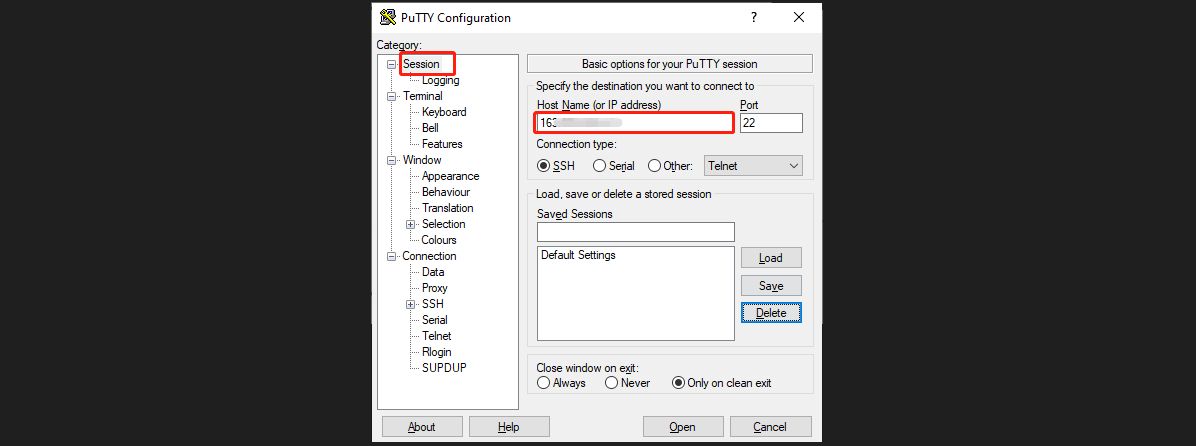
- In the PuTTY Configuration window, enter the following content as shown in the figure below.
Under Session Category- Host Name (or IP address):The public IP of the Linux server.
- Port: The default port is 22. If the port has been changed, please use the updated one.
- Connection Type: Select SSH.
Note: The connection information can be found on the overview page in the control panel. If you have difficulty in finding the right information, please refer to the guide on how to manage your server.
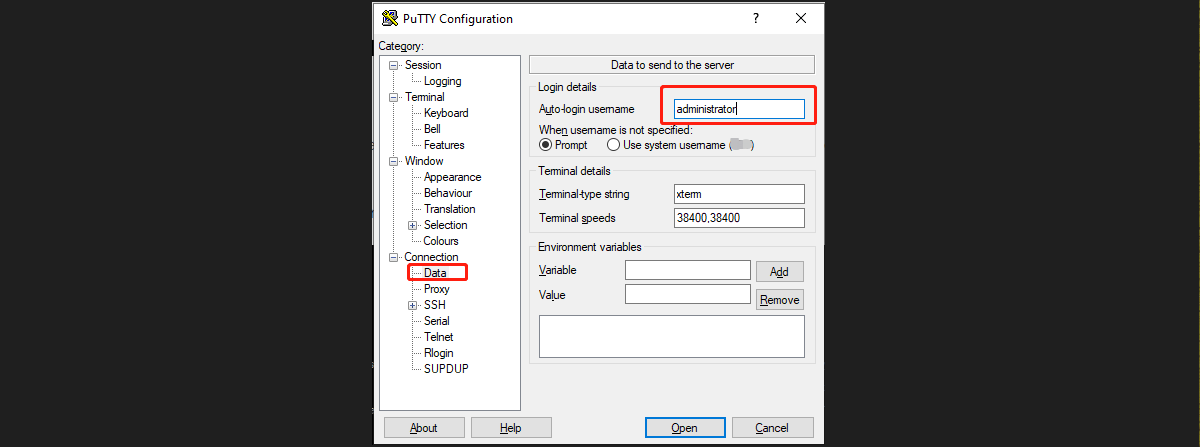
Under Connection Category - Data
- Auto-login username: Enter the username you are about to log in to. In this example, we use an administrator.
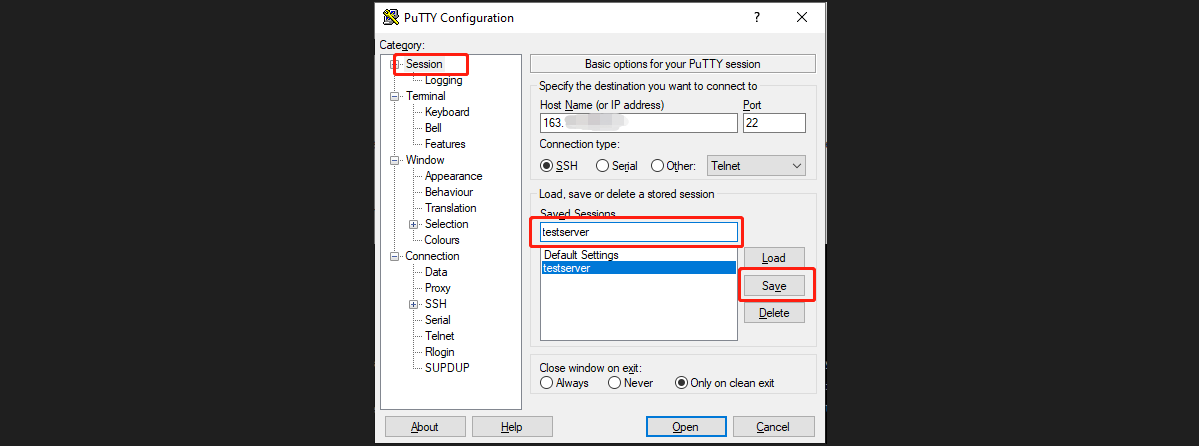
Return to Session Category
- Saved Sessions: Configure a name for this session and click Save. Each time, you can directly double-click Saved Sessions to log in to the server.
2. Log in to the Linux Dedicated server
- When you are taken to the PuTTY running interface, which prompts the following:
Using username "auto-login username"
auto-login name@IP's password:- Enter the password after "password" and press Enter. The entered password is not displayed by default, as shown in the figure below. In the SSH session, right-clicking the mouse will paste the content in the clipboard. If you have copied a password, simply right-click after the password line and press Enter. Then, you should be able to log in to the session.

Initial Checks After Login
After you have successfully connected to the Dedicated server, you can check:
- Whether the operating system version, CPU, RAM, disk, bandwidth, add-ons, and other resources match your purchase.
- After you confirm everything is fine, you are free to install any software you need and start your project.
Other Dedicated Server Connection Methods
Here, we only show how to connect from Windows to a Windows server and from Windows to a Linux server.
We also have many knowledge base (KB) articles covering connections from different devices and using various tools, such as macOS, mobile devices, or third-party software like AnyDesk.
For detailed instructions on these methods, please visit the Dedicated Server usage guide section.
Dedicated Server Usage Guide
Windows Dedicated Server Guidance
Linux Dedicated Server Guidance
Dedicated Server Upgrades
As your business grows or resource demands increase, you can upgrade your Dedicated server hosting package
1. Upgrade to Another Dedicated Server
For higher performance requirements or larger workloads, you can choose to upgrade to another dedicated server. To upgrade, please contact us for help. Since the upgrade involves switching to a different machine, the IP address will change, and you will need to migrate your data manually. You can explore Dedicated Server Offerings.
2. Purchase Add-ons Individually
If you only need to increase a specific resource (such as CPU, RAM, storage, or bandwidth), you can purchase add-ons individually directly via Control Panel → Overview → Addon-Options: Log in to the control panel and upgrade.
3. Horizontal Scaling
You can also expand your resources by adding one or more physical servers, thereby increasing overall computing power and system capacity. Horizontal scaling not only supports higher concurrent processing and large-scale data storage but also enables load balancing and redundant backups, improving the stability and reliability of your business operations.
Dedicated Hosting Usage Restrictions
To provide you with a more stable and secure experience, we have established certain usage restrictions for our dedicated hosting services. These limitations are designed to prevent resource abuse and potential risks, ensuring that all customers can operate their businesses in a fair and reliable environment.
Below are some common usage restrictions:
| Category | Examples / Restrictions |
|---|---|
| Prohibited and Restricted Content | Pornographic content; Illegal or violent content; Hate speech; Illegal or defamatory content; Fraud and phishing |
| Network Security and Abuse | Network attacks; Vulnerability scanning; Bypassing security measures; Unauthorized access; System interference; Abuse of non-public APIs; Unauthorized promotion |
| Copyright and Intellectual Property Infringement | Copyright infringement; IRC services; BT/P2P programs |
| Resource Abuse and Service Violations | Resource abuse / high resource consumption; Unauthorized network services; Spam |
These actions will cause direct suspension/cancellation/termination of your service without the possibility of refund. You can refer to the Terms of Service for more details.